
Habitat
This species is found on the ground or occasionally on decaying wood in broad-leaved, coniferous, or mixed forests. It is most commonly associated with beech and oak trees. It grows singly, in scattered clusters, or in small groups and forms mycorrhizal relationships with its host trees.
Photos
Appearance
- Cap
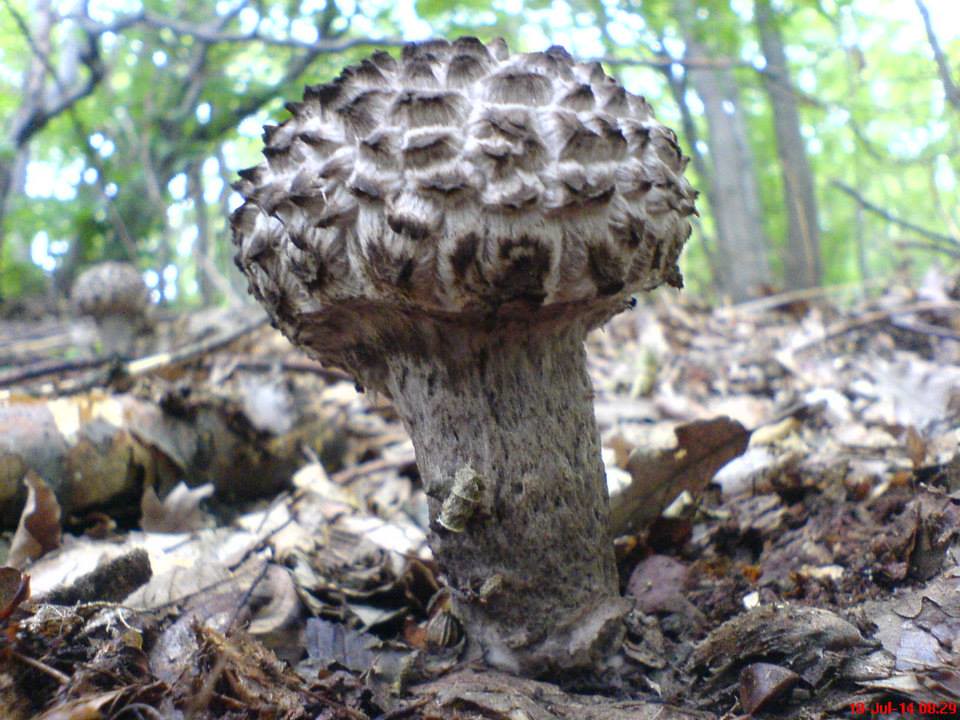
- 5–15 cm wide; initially hemispherical then flattening; the dry surface is densely covered in thick, shaggy, wart-like scales that are smoke-grey to black. The margin often has a ragged edge with overhanging woolly patches.
- Stem
- 4–14 cm long, 1–2 cm wide; often tapering downward or slightly enlarged at the base; colored similarly to the cap and covered in coarse scales. A shaggy, gray cottony ring or sheath is often present.
- Pores
- Large and angular; white to grey, eventually becoming olive-green to blackish; specifically stains pinkish-red to coral when bruised or injured.
- Tubes
- White to grey; adnate to slightly decurrent; bruising reddish before turning darker.
- Flesh
- White and firm to spongy; rapidly changes color when cut, turning vinaceous or coral pink, then eventually brown or black. Becomes woody in the stem with age.
- Spore print
- Violaceous-black to purple-black.
Sporecast is better in the app
Plan ahead with 10-day forecasts, see what people are finding nearby, get photo IDs, and track your finds.
Edibility
This mushroom is edible when young, though it is often considered not worthwhile or unappealing in texture. The flesh is spongy and the stem becomes woody and tough as it ages. It has a mild to earthy smell and taste, and it may be confused with Strobilomyces confusus or Strobilomyces dryophilus, which are distinguished primarily by microscopic spore features.
Misidentification can be fatal. Never eat a mushroom unless you're 100% sure. This information may be inaccurate. Always consult multiple sources.
Nutrient Source
EctomycorrhizalIt forms a mutually beneficial relationship with trees, exchanging nutrients with them.
Common Names
- Basque
- onddo ezkatatsu, onto ezkatatsua
- Catalan
- mataparent d´esquames, mataparent d´escames, boletó-escamoso
- Danish
- Koglerørhat
- Dutch
- Geschubde boleet
- English
- Old Man Of The Woods
- French
- Bolet pomme de pin
- German
- Strubbelkopfröhrling
- Norwegian Bokmål
- skjellrørsopp
- Norwegian Nynorsk
- skjelrøyrsopp
- Spanish
- Boleto escamoso
- Swedish
- fjällsopp
- Ukrainian
- Шишкогриб лускатий
- Welsh
- Hen Ŵr y Coed
Synonyms
- Boletus cinereus
- Boletus floccipes
- Boletus floccopus
- Boletus floccopus
- Boletus floccopus
- Boletus strobilaceus
- Boletus strobilaceus
- Boletus strobiliformis
- Boletus strobiliformis
- Boletus strobilinus
- Eriocorys strobilacea
- Strobilomyces floccopus
- Strobilomyces strobiliformis
- Suillus cinereus