
Habitat
This species grows in grass, leaf litter, and organic or mulched soil. It is frequently found in gardens, parklands, wood chips, and waste ground, and it sometimes occurs on dunes or in areas with stinging nettles. It typically fruits in solitary, scattered, or small groups.
Photos
Appearance
- Cap
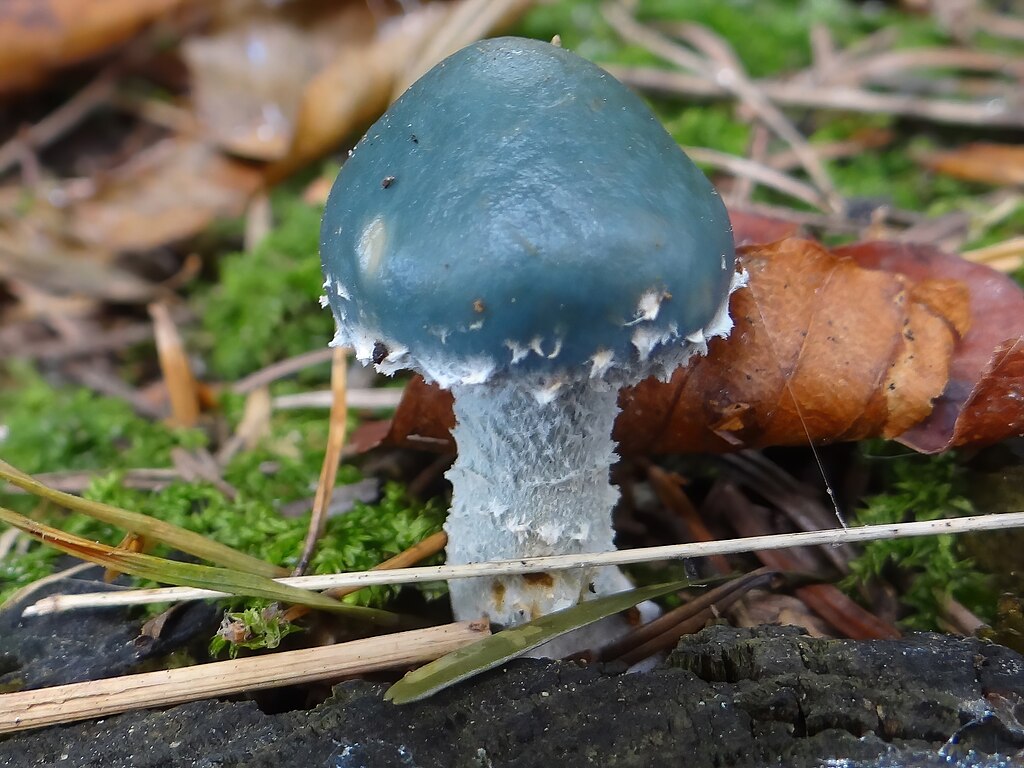
- 3–8 cm wide; initially blue-green to turquoise, fading from the center to straw-yellow or pale buff; convex to flattened with a broad central bump; surface is slimy or sticky and often has fine white veil fragments or scales near the edge when young.
- Stem
- 3–10 cm long and 0.3–1.2 cm thick; similar in color to the cap, fading to whitish or buff; slender and equal or slightly tapering; the surface may be woolly or scaly below the ring zone.
- Gills
- Attached to slightly descending; close or crowded; initially pale grey-buff or pallid, maturing to tobacco-brown or dark vinaceous-brown.
- Flesh
- Moderately thin and soft; pale blue-green when young, becoming whitish-buff or creamy in age.
- Partial veil
- A thin, fleeting ring or ring zone that often disappears as the mushroom matures.
- Spore print
- Umber-brown to dark purple-brown or purple-black.
Sporecast is better in the app
Plan ahead with 10-day forecasts, see what people are finding nearby, get photo IDs, and track your finds.
Edibility
This mushroom is sometimes reported to contain the psychoactive compounds psilocybin and psilocin. It has no distinctive taste or smell and is frequently confused with Stropharia aeruginosa, which typically has a more intense blue-green color and more prominent white veil remnants.
Misidentification can be fatal. Never eat a mushroom unless you're 100% sure. This information may be inaccurate. Always consult multiple sources.
Nutrient Source
SaprotrophicIt obtains nutrients by breaking down dead organic material found in soil, leaf litter, and wood.
Common Names
- Dutch
- Valse kopergroenzwam, valse kopergroenzwam
- English
- Blue Roundhead
- Finnish
- tarhakaulussieni
- German
- Blauer Träuschling
- Ukrainian
- Строфарія небесно-блакитна
- Welsh
- Pengrwn Glas
Synonyms
- Agaricus politus
- Psilocybe caerulea