
Habitat
Found strictly in association with larch trees. It grows on the ground, appearing as solitary individuals, small groups, or large troops. The species is widespread globally, occurring naturally or in urban settings wherever larch has been introduced.
Photos
Appearance
- Cap
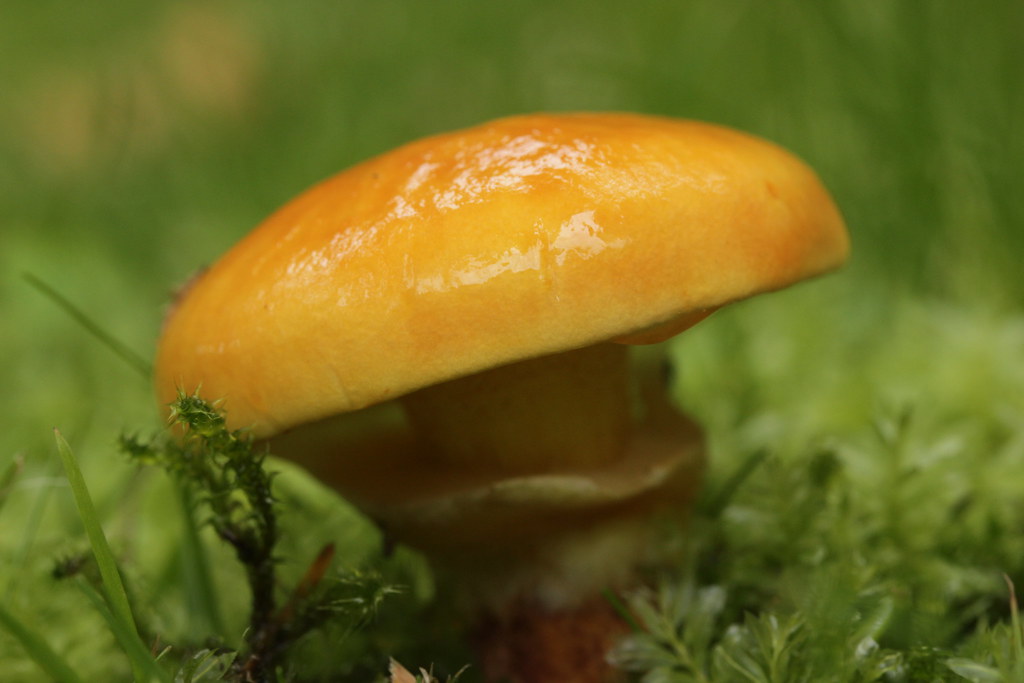
- 3 to 15 cm across; ranging from bright yellow and orange to deep reddish-brown or mahogany, often with a yellow margin. Shape is initially hemispherical or conical, becoming convex to flat; surface is smooth and notably slimy or glutinous when wet, becoming shiny when dry.
- Stem
- 4 to 11 cm long; cylindrical or slightly swollen at the base. The color is yellow to reddish-brown, often darker toward the base. It features a persistent, cottony or membranous ring from the partial veil, which may have a gelatinous yellow coating.
- Pores
- Small and angular; lemon yellow to golden yellow, maturing to ochre or olive tones and bruising reddish-brown or rust-colored.
- Tubes
- Pale yellow to ochraceous; 0.5 to 1.5 cm long, attached broadly to slightly descending the stem.
- Flesh
- Pale yellow to lemon yellow in the cap, typically darker in the stem. Texture is firm when young but becomes very soft and squishy with age. It may stain ochre-brown when cut, and the stem base sometimes exhibits blue or green discolorations.
- Spore print
- Ranging from ochraceous to olive-brown or red-brown.
Sporecast is better in the app
Plan ahead with 10-day forecasts, see what people are finding nearby, get photo IDs, and track your finds.
Edibility
While widely eaten, this mushroom can cause gastric upset in some individuals even when cooked, and it is slightly toxic if consumed raw. The flavor and odor are typically faint and pleasant, though some find the taste indistinct or slightly unpleasant. It has no poisonous lookalikes, but it can be confused with the very rare Bearded Bolete or Suillus ponderosus, which grows with Douglas-fir rather than larch.
Misidentification can be fatal. Never eat a mushroom unless you're 100% sure. This information may be inaccurate. Always consult multiple sources.
Nutrient Source
EctomycorrhizalIt forms a symbiotic relationship with larch trees, exchanging nutrients with them.
Common Names
- Basque
- onddo apain, onto apain, onddo apai, Onto apain, onto apai
- Danish
- Lærke-slimrørhat
- Dutch
- Gele ringboleet
- English
- Larch Slippery Jack, Larch Bolete, Greville's Bolete
- Finnish
- lehtikuusentatti, turjantatti
- French
- Bolet élégant
- German
- Goldröhrling
- Norwegian Bokmål
- lerkesopp
- Norwegian Nynorsk
- lerkesopp
- Scottish Gaelic
- seocan sleamhainn na learaig, seoc sleamhainn na learaig
- Spanish
- seta de alerce, boleto elegante, boleto amarillo anillado, boleto del alerce, Boleto elegante
- Swedish
- Lärksopp
- Welsh
- Boled Llarwydd
Synonyms
- Boletinus grevillei
- Boletopsis elegans
- Boletus annularius
- Boletus clintonianus
- Boletus cortinatus
- Boletus elegans
- Boletus elegans
- Boletus flavus
- Boletus grevillei
- Boletus theclae
- Cricunopus elegans
- Ixocomus elegans
- Ixocomus grevillei
- Solenia elegans
- Suillus clintonianus
- Suillus clintonianus
- Suillus clintonianus
- Suillus cortinatus
- Suillus elegans
- Suillus proximus
- Viscipellis elegans