
Habitat
S. luteus grows on the ground in association with conifers, specifically pines of all types. It is commonly found with Scots pine, red pine, black pine, and eastern white pine. This species frequently occurs on acidic soils and is often found in mixed forests, on road banks, on lawns, and in urban environments near planted trees. Known as an ecological pioneer, it readily kolonizes new pine plantations and has achieved a worldwide distribution as an introduced species. It fruits solitary, in clusters, or occasionally in large troops.
Photos
Appearance
- Cap
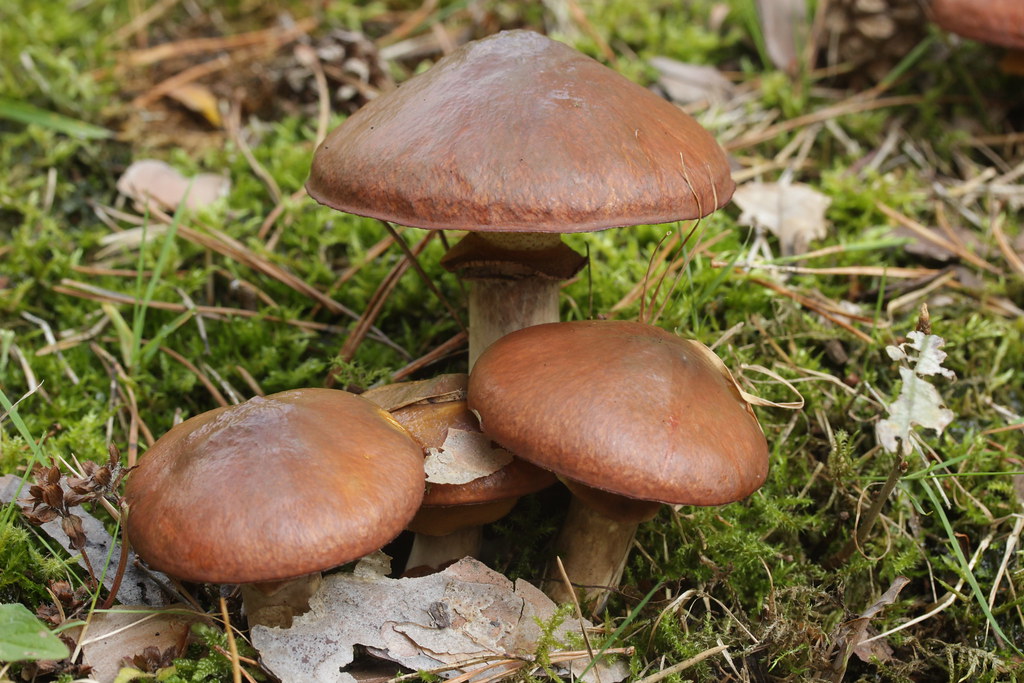
- 4–12 cm wide, varying from chocolate or chestnut brown to reddish-brown or yellow-brown, often developing dark streaks or olive tones with age. Hemispherical to convex, becoming flat, with a smooth surface that is heavily slimy and glutinous when wet but shiny and sometimes wrinkled when dry. The skin is peelable.
- Stem
- 3–10 cm long, 1–3 cm thick, cylindrical to club-shaped. Whitish to pale yellow above the ring and covered in prominent glandular dots that darken with age; the base can become wine-red or brownish. The surface is often greasy or sticky.
- Ring
- Large, persistent, and membranous, forming a flaring skirt. It is white to cream on top with a distinct purplish to sepia-colored gelatinous underside, eventually collapsing or darkening with age.
- Pores
- Small, round to slightly irregular; lemon-yellow to straw-colored when young, maturing to golden, olive-yellow, or orangish-brown. They do not stain when bruised.
- Tubes
- Shallow, 0.2–1 cm long, adnate or slightly sunken around the stem attachment; colored similar to the pores.
- Flesh
- Soft and thick; white to creamy, becoming yellowish in the cap and often tinted wine-red or purplish at the very base of the stem.
- Spore print
- Cinnamon to ochraceous-brown.
Sporecast is better in the app
Plan ahead with 10-day forecasts, see what people are finding nearby, get photo IDs, and track your finds.
Edibility
The flavor and taste are generally mild or indistinct, but the flesh is soft and becomes very slimy when cooked. To improve the texture, it is recommended to peel the glutinous skin off the cap or to dry and powder the mushrooms for use as a seasoning. While edible, it has been reported to cause diarrhea in some cases. It can be confused with other edible Suillus species, such as Suillus brevipes, which lacks a veil, or Suillus flavidus and Suillus clintonianus, which associate with different trees or have differing pore and staining characteristics.
Misidentification can be fatal. Never eat a mushroom unless you're 100% sure. This information may be inaccurate. Always consult multiple sources.
Nutrient Source
EctomycorrhizalIt forms a symbiotic relationship with the roots of coniferous trees, exchanging nutrients from the soil for sugars produced by the tree through photosynthesis.
Common Names
- Basque
- onto-likin, onto-eraztunduna, pinui-onddo likin, onto likin
- Catalan
- Pinetell de calceta, molleric, moleric de calceta
- Danish
- Brungul slimrørhat
- Dutch
- Bruine ringboleet
- English
- Purple-veiled Slippery Jack, Slippery Jack
- Finnish
- voitatti
- French
- Nonnette voilée
- German
- Butterpilz
- Northern Sami
- vuodjagusaguoppar
- Norwegian
- matsopp
- Norwegian Bokmål
- smørsopp
- Norwegian Nynorsk
- smørsopp
- Spanish
- Pastor, Boleto anillado, hongo anillado, boleto viscoso anillado, babosa
- Swedish
- Smörsopp
- Welsh
- Boled Llithrig
Synonyms
- Boletopsis lutea
- Boletus annularius
- Boletus luteus
- Boletus luteus
- Boletus luteus
- Boletus volvatus
- Cricunopus luteus
- Ixocomus luteus
- Solenia lutea
- Suillus annulatus
- Suillus luteus — Purple-veiled Slippery Jack
- Viscipellis lutea