
Habitat
Associated with conifers, specifically pine, this species thrives on acidic soils in woodlands and heathland. It is often found among heather and occasionally occurs on decaying conifer wood, appearing either alone or in small clusters.
Photos
Appearance
- Cap
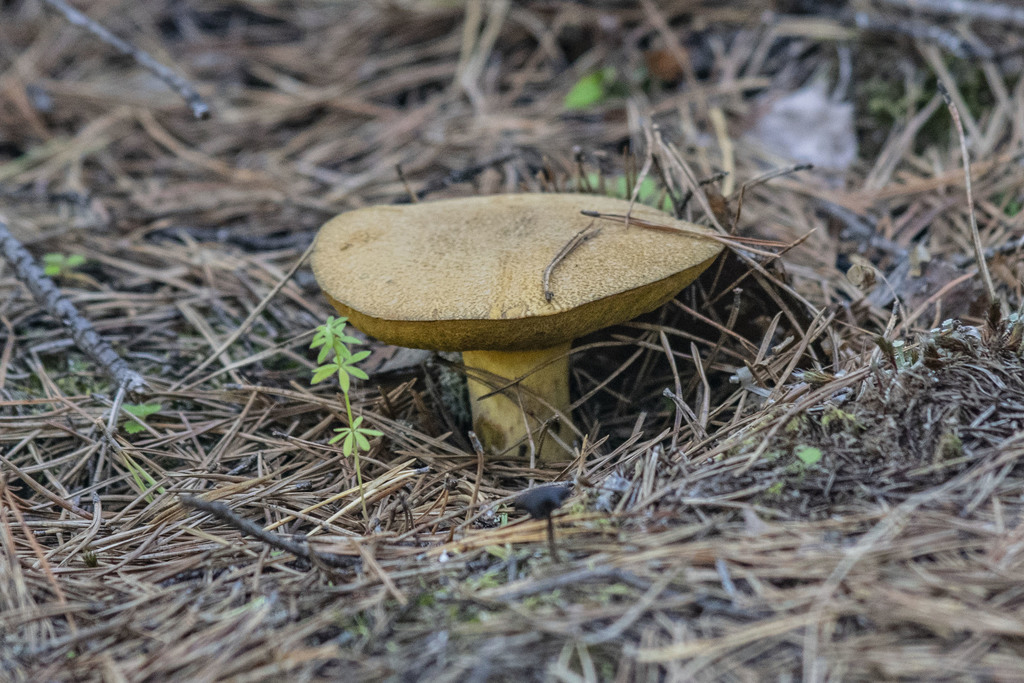
- 6-13cm wide; hemispherical to flat-convex; rusty-orange, tawny, or olive-ochre; surface is velvety or downy with small, flattened dark scales; slightly tacky when wet but less slimy than others in the genus.
- Stem
- 5-10cm long; cylindrical to club-shaped; yellow or ochre at the top, becoming rust-colored or darker brown toward the base; base may have a flattened plate of mycelium.
- Pores
- Angular and unequal in size; initially dark straw or ochre-yellow with olive tints, maturing to cinnamon; may bruise bluish-green.
- Tubes
- Dark buff to light brown; adnate or slightly decurrent.
- Flesh
- Firm but softening with age; pale lemon yellow in the cap and darker ochre or brown at the stem base; often bruises or tints faintly blue when cut.
- Spore print
- Walnut brown.
- Smell and taste
- Strong, earthy, or fungusy smell; taste is acidic or pleasant with a distinctive metallic element.
Sporecast is better in the app
Plan ahead with 10-day forecasts, see what people are finding nearby, get photo IDs, and track your finds.
Edibility
This mushroom has a strong earthy or fungusy smell and an acidic to metallic taste. While the yellow flesh is firm, it may stain faintly blue when cut, and the pores often bruise bluish-green. It lacks poisonous lookalikes and is less slimy than other species in its genus.
Misidentification can be fatal. Never eat a mushroom unless you're 100% sure. This information may be inaccurate. Always consult multiple sources.
Nutrient Source
EctomycorrhizalThis fungus forms a symbiotic relationship with trees, exchanging nutrients and water with the tree's root system. It obtains sugars from the tree in return for essential minerals and water absorbed from the soil.
Common Names
- Basque
- klorousain, pinudi-onddo, pinudi-onddo klorousain
- Catalan
- mataparent, mataparent clapat
- Danish
- Broget slimrørhat
- Dutch
- Fijnschubbige boleet
- English
- Velvet Bolete
- Finnish
- kangastatti
- French
- Bolet moucheté
- German
- Sandröhrling
- Northern Sami
- guolbagusaguoppar
- Norwegian Bokmål
- sandsopp
- Norwegian Nynorsk
- sandsopp
- Spanish
- hongo de olor a cloro, boleto variegado, boleto manchado
- Swedish
- Sandsopp, sandsopp
- Welsh
- Boled Melfed
Synonyms
- Boletopsis squalida
- Boletus aureus
- Boletus guttatus
- Boletus squalidus
- Boletus variegatus
- Boletus variegatus
- Ixocomus variegatus
- Suillus squalidus
- Suillus variegatus
- Suillus variegatus
- Versipellis guttata
- Versipellis variegata
- Viscipellis velifera
- Viscipellis velifera