
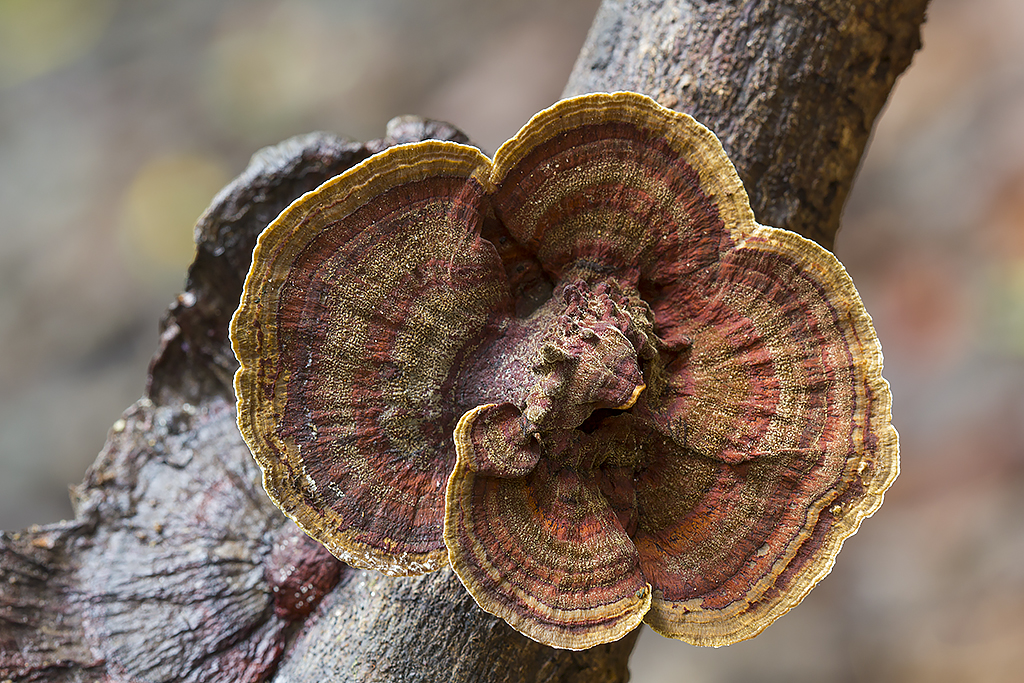
Habitat
This extremely common and widespread species grows on dead deciduous wood, including logs, stumps, fallen branches, and standing dead trees. While it primarily acts as a saprobe causing white rot, it can also function as a weak parasite on broad-leaved trees. It is most frequently found on hardwoods like live oak, tanoak, and cottonwood, but it occasionally occurs on conifers—such as Monterey cypress—and sawn timber. Fruit bodies typically grow in densely overlapping tiered groups, rows, or rosette clusters.
Photos
Appearance
- Fruit body
- Small, thin, leathery brackets measuring 2–10 cm across; shaped like fan-like shelves, kidneys, or rosettes. Commonly grows in dense, overlapping, tiered clusters.
- Cap
- Features striking, multi-colored concentric zones in shades of brown, gray, blue, black, reddish, or ochre, usually with a distinct white or pale margin. The surface texture alternates between velvety-hairy and smooth zones; may appear greenish with age due to algae.
- Pores
- Very small and crowded (3–6 per mm), circular to slightly angular. Color is white to cream, sometimes aging to yellowish, buff, or light brown.
- Tubes
- A very thin layer, generally 0.5–3 mm deep, colored white to cream.
- Flesh
- White to creamy, tough, and flexible or leathery. Includes a thin, dark line visible just beneath the fuzzy upper surface layer.
- Stem
- Absent; the fungus attaches broadly or laterally to the wood substrate.
- Spore print
- White to very pale yellowish or cream.
- Odor and Taste
- Inconspicuous or not distinctive.
Sporecast is better in the app
Plan ahead with 10-day forecasts, see what people are finding nearby, get photo IDs, and track your finds.
Edibility
While not considered poisonous, this mushroom is inedible due to its tough, leathery, and fibrous texture. It is frequently dried and powdered for use in teas or tinctures owing to its long history in traditional medicine and ongoing research into its immune-boosting and anti-cancer properties. It can be confused with species of Stereum, which have a smooth lower surface without pores, or Trichaptum species, which feature lilac to violet-tinged pore surfaces. Several other Trametes species are similar, such as T. hirsuta, which is thicker and more hairy, and T. suaveolens, which possesses a sweet anise odor.
Misidentification can be fatal. Never eat a mushroom unless you're 100% sure. This information may be inaccurate. Always consult multiple sources.
Nutrient Source
SaprotrophicIt gains nutrients by decomposing dead organic matter, such as wood and leaves, using enzymes to break down complex materials. It is also known as a white-rot fungus, specifically noted for its ability to break down lignin, a major component of wood. [sciencedirect.com](https://www.sciencedirect.com/science/article/abs/pii/S1164556317301048), [wikipedia.org](https://en.wikipedia.org/wiki/Trametes_versicolor)
Common Names
- Catalan
- bolet de soca delors
- Danish
- Broget læderporesvamp
- English
- Turkeytail, Turkey-tail
- French
- Tramète versicolore, Tramète à couleur changeante
- Norwegian
- buntsopp, spragelpils, sprangelsopp
- Norwegian Bokmål
- silkekjuke
- Norwegian Nynorsk
- silkekjuke
- Spanish
- yesquero de varioslores, Yesquero delores, yesquero multicolor, yésquero multicolor
- Swedish
- sidenticka
- Welsh
- Cwnffon Twrci
Synonyms
- Agarico-suber versicolor
- Agaricus versicolor
- Agaricus versicolor
- Agaricus versicolor
- Bjerkandera versicolor
- Boletus versicolor
- Coriolus antarcticus
- Coriolus versicolor
- Coriolus versicolor
- Hansenia versicolor
- Microporus antarcticus
- Microporus fuscatus
- Microporus nigricans
- Microporus versicolor
- Pleuropus versicolor
- Polyporus antarcticus
- Polyporus argyraceus
- Polyporus fuscatus
- Polyporus nigricans
- Polyporus versicolor
- Polystictus aequus
- Polystictus antarcticus
- Polystictus antarcticus
- Polystictus fuscatus
- Polystictus nigricans
- Polystictus nigricans
- Polystictus versicolor
- Poria versicolor
- Sistotrema versicolor