
Habitat
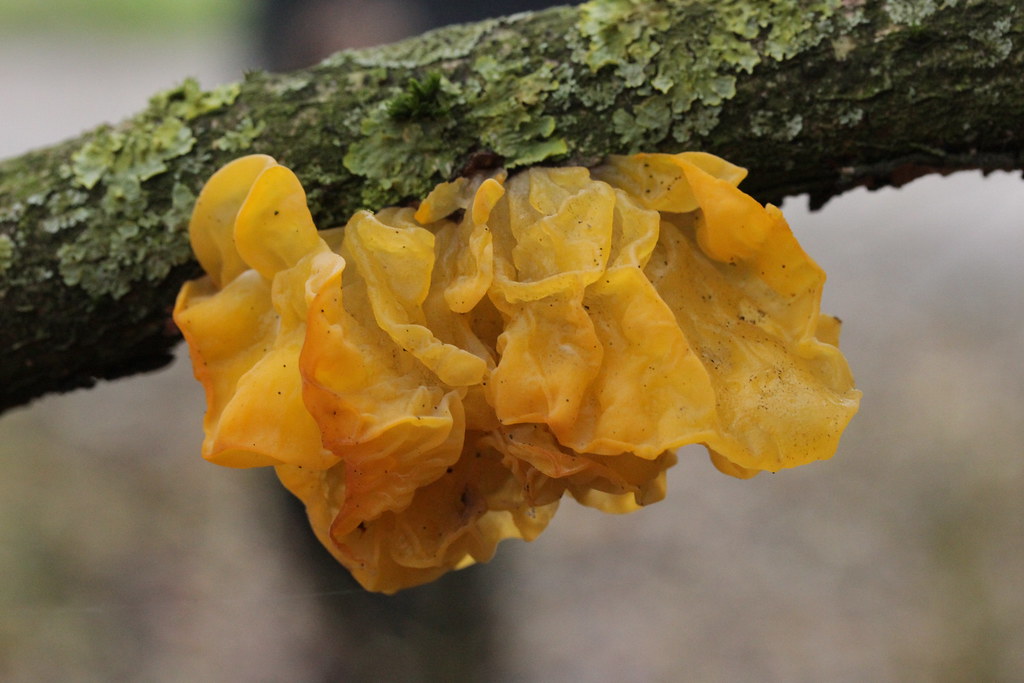
This common species is found on the dead or decaying wood of deciduous trees, including fallen branches, logs, and stumps. It can also occur on dead branches still attached to the tree. While it appears to grow directly from the wood of various hardwoods—such as alder, hazel, gorse, ash, beech, and birch—it is actually a parasite that feeds on the mycelium or fruiting bodies of wood-decay fungi, specifically members of the genus Peniophora (and occasionally Diatrype disciformis).
Photos
Appearance
- Fruit body
- A gelatinous mass measuring 2-10 cm across, initially shaped like small knobs or cushions and maturing into a brain-like or irregularly folded structure with leaf-like lobes. The surface is smooth, shiny, and greasy, ranging in color from bright yellow-orange to golden-yellow, becoming paler or translucent as it ages and drying to a dark orange.
- Flesh
- Soft and jelly-like when moist, becoming rubbery, tough, or brittle and horny when dry.
- Spore print
- White to yellowish or pale orange.
- Stem
- Absent, though sometimes attached to the wood at a single compact point of the same color as the body.
Sporecast is better in the app
Plan ahead with 10-day forecasts, see what people are finding nearby, get photo IDs, and track your finds.
Edibility
This species has a soft, gelatinous texture with an indistinct taste and odor. Foragers should be aware of several similar yellow jelly fungi, specifically Dacrymyces palmatus and Dacrymyces chrysospermus, which typically grow on conifers and often feature a white rooting base. It may also be confused with Naematelia aurantia, which has more tightly convoluted, brain-like lobes and grows alongside Stereum fungi.
Misidentification can be fatal. Never eat a mushroom unless you're 100% sure. This information may be inaccurate. Always consult multiple sources.
Nutrient Source
ParasiticIt is a parasite that obtains nourishment by digesting the tissues of another fungus, which in turn is parasitizing a tree.
Synonyms
- Helvella mesenterica
- Tremella brasiliensis
- Tremella lutescens
- Tremella lutescens