
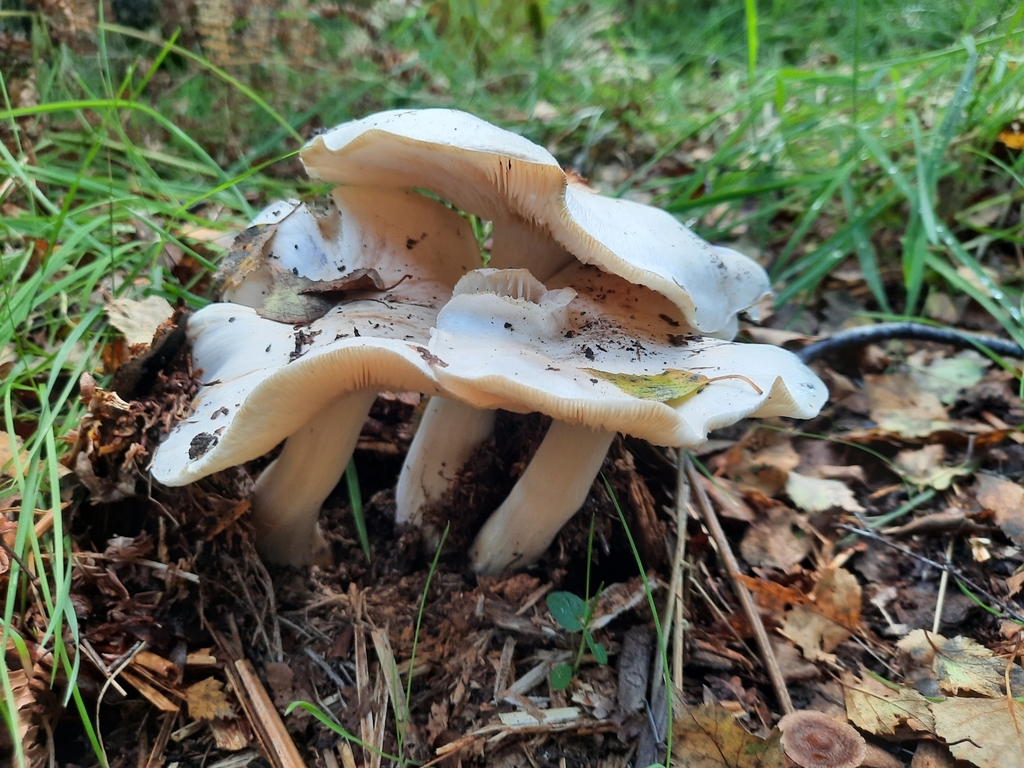
Habitat
This mushroom grows on soil in deciduous, coniferous, and mixed woodland. It is most frequently found in association with oak or beech trees, typically appearing in small groups or as individual specimens.
Photos
Appearance
- Cap
- 5–10 cm wide; initially conical or convex, eventually flattening and becoming wavy; the surface is silky white, smooth to finely scaly, and slightly sticky when moist; mature specimens frequently develop spots of pink, violet-blue, or green.
- Stem
- 4–14 cm long and 1–2 cm thick; stout and cylindrical or tapering toward the base; the surface is white and fibrous, often featuring a distinct blue-green tint or spots at the base; sometimes appears to be rooting into the substrate.
- Gills
- White and closely packed; attachment ranges from notched or attached to nearly free from the stem.
- Flesh
- White and firm in texture.
- Spore print
- White.
- Smell
- Faint and mild; sometimes described as having a flour-like scent.
- Taste
- Mild and non-distinctive, or slightly floury.
Sporecast is better in the app
Plan ahead with 10-day forecasts, see what people are finding nearby, get photo IDs, and track your finds.
Edibility
This mushroom is considered a delicacy with a mild or floury taste, though its texture can be somewhat fibrous. Foragers must be extremely cautious as it can be confused with deadly Amanita species, the poisonous White Knight which has a bitter taste, and the Livid Pinkgill which has a strong, unpleasant odor. It also closely resembles the White Domecap, but can sometimes be distinguished by its tendency to develop blue, green, or pink spots as it ages.
Misidentification can be fatal. Never eat a mushroom unless you're 100% sure. This information may be inaccurate. Always consult multiple sources.
Nutrient Source
EctomycorrhizalIt forms a symbiotic relationship with tree roots, exchanging nutrients and minerals from the soil for sugars produced by the tree.
Common Names
- Danish
- Silke-ridderhat
- Dutch
- Witte duifridderzwam
- English
- Blue Spot Knight
- Finnish
- silkkivalmuska
- French
- Colombette
- German
- Seidiger Ritterling
- Norwegian Bokmål
- silkemusserong
- Norwegian Nynorsk
- silkemusserong
- Swedish
- silkesmusseron
- Welsh
- Marchog Colomennaidd
Synonyms
- Agaricus columbetta
- Agaricus impolitus
- Cortinellus columbetta
- Gyrophila columbetta
- Gyrophila impolita
- Tricholoma columbetta
- Tricholoma impolitum
- Tricholoma impolitum