
Habitat
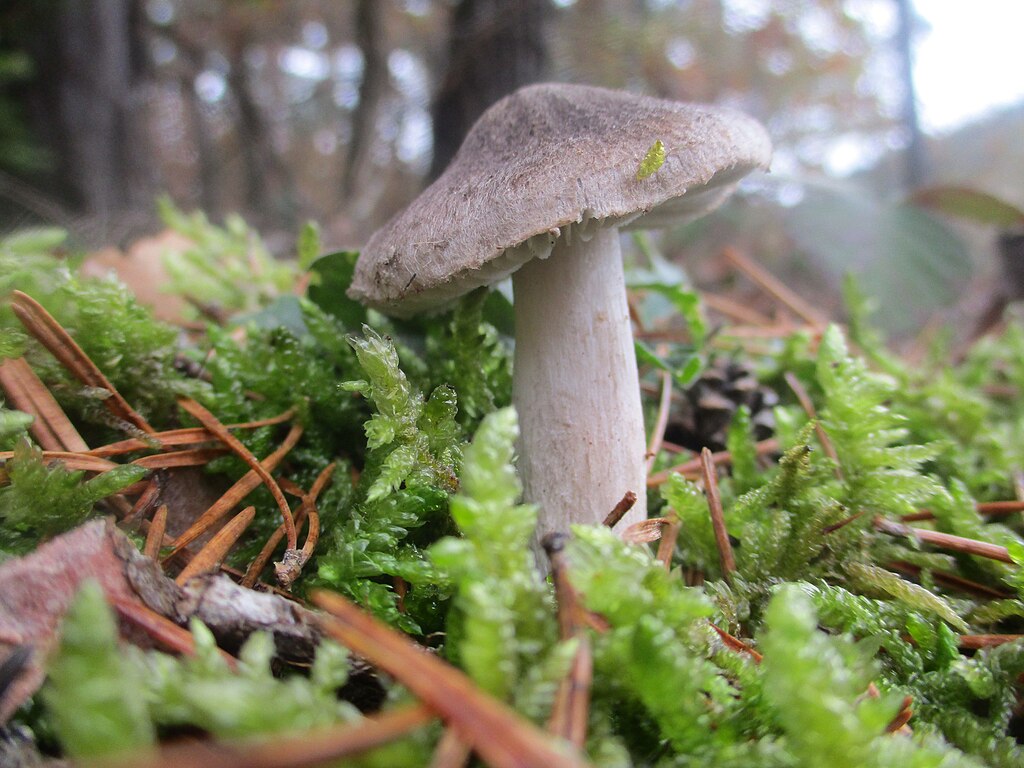
This mushroom is primarily found on the ground or leaf litter in coniferous and mixed woodlands. It shows a strong preference for pine but is also found with spruce or Douglas-fir, particularly within plantations. It typically grows in small groups, scattered clusters, or fairy rings.
Photos
Appearance
- Cap
- 1.5–9 cm wide; ranging from conical or bell-shaped to convex, often developing a low, broad umbo and flattening with age; color is mouse gray to dark grayish-black, sometimes brownish-gray or lighter toward the wavy, inrolled margin; texture is dry, downy, felty, or matted-tomentose, often covered in tiny gray to black scales or fibers.
- Stem
- 2–9 cm long, 0.4–1.5 cm thick; cylindrical or slightly bulbous at the base; white to pale gray, sometimes discoloring yellowish when handled; surface is silky-smooth to finely fibrous or downy, especially at the apex.
- Gills
- Attached with a notch (emarginate to adnexed) or appearing nearly free; white to pale gray, occasionally with darker spots; spacing varies from close to relatively distant; broad with multiple tiers of shorter subgills.
- Flesh
- Thin and fragile; white to pale grayish; stem flesh is fibrous and may become hollow.
- Spore print
- White.
- Partial veil
- Often absent or consisting of a faint, cobweb-like (cortina) structure leaving gray hairs on the stem, typically only visible on young specimens.
Sporecast is better in the app
Plan ahead with 10-day forecasts, see what people are finding nearby, get photo IDs, and track your finds.
Edibility
While traditionally considered edible with a mild flavor, this species is now known to cause rhabdomyolysis and contains toxins identified by researchers in 2014. It is easily confused with numerous other grey Tricholoma species of unknown or dubious safety, including the poisonous Leopard Knight (T. pardinum) which causes severe gastric upset. Identification is difficult because multiple similar species are often grouped under this name, and it should be distinguished from T. scalpturatum, which has a farinaceous odor and taste.
Misidentification can be fatal. Never eat a mushroom unless you're 100% sure. This information may be inaccurate. Always consult multiple sources.
Nutrient Source
EctomycorrhizalIt forms symbiotic associations with tree roots, exchanging nutrients with the tree.
Common Names
- Danish
- Muse-ridderhat, Jordfarvet ridderhat
- Dutch
- muisgrijze ridderzwam, Muisgrijze ridderzwam
- English
- Grey Knight
- Finnish
- harmaavalmuska
- French
- Tricholome terreux, Petit-gris, Petit gris
- German
- Erd-Ritterling, Mausgrauer Erd-Ritterling
- Swedish
- jordmusseron, gråmusseron
- Welsh
- Marchog Llwyd
Synonyms
- Agaricus madreporeus
- Agaricus myomyces
- Agaricus myomyces
- Agaricus myomyces
- Agaricus pullus
- Agaricus terreus
- Cortinellus terreus
- Gymnopus myomyces
- Gyrophila terrea
- Tricholoma bisporigerum
- Tricholoma chrysites
- Tricholoma myomyces
- Tricholoma terreum
- Tricholoma terreum