
Habitat
This species grows just beneath the soil surface in broad-leaved woodlands, primarily associating with beech trees. It favors alkaline or chalky soils and can be found growing individually or in clusters ranging from small groups to very large numbers.
Photos
Appearance
- Fruit body
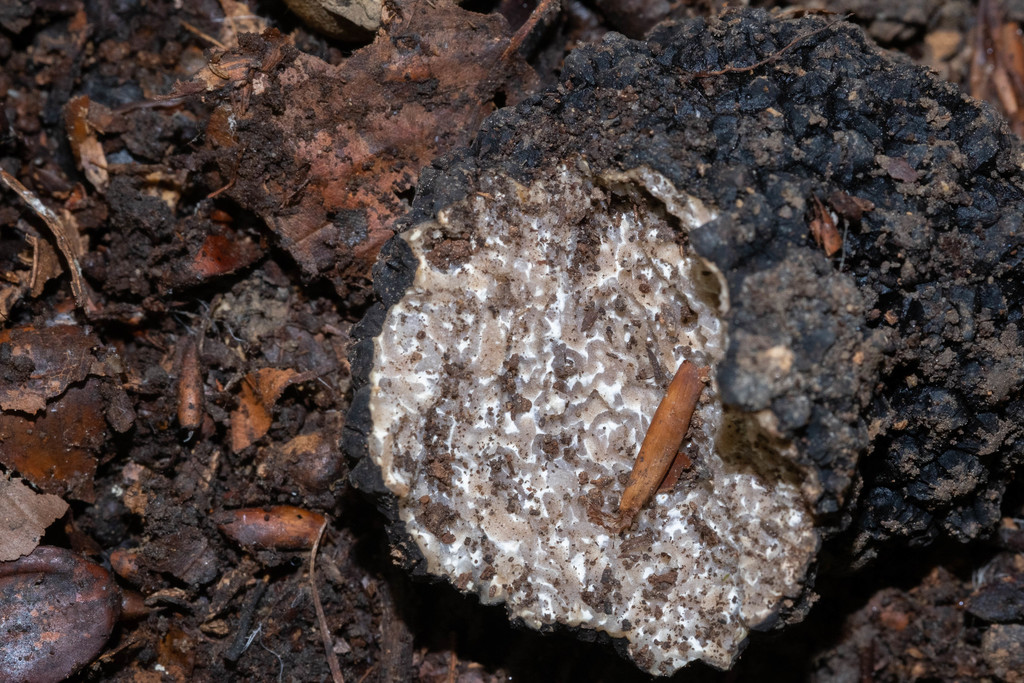
- Measuring 3 to 9 cm across, this subterranean fungus is dark brown to black and roughly spherical, featuring a surface densely covered in four-to-six-sided pyramidal warts.
- Flesh
- Initially white, the interior matures to yellow-brown or grey-brown and is defined by a distinct marbled pattern of alternating dark and white veins.
- Smell
- Very strong and pleasant, described as sweet-chemical or reminiscent of seaweed.
- Taste
- Characterized by a pleasant, nutty flavor.
Sporecast is better in the app
Plan ahead with 10-day forecasts, see what people are finding nearby, get photo IDs, and track your finds.
Edibility
This mushroom has a pleasant, nutty taste accompanied by a strong, sweet-chemical or seaweed scent. The white flesh is marbled with veins and darkens as it matures. It is the only well-known truffle found in the British Isles.
Misidentification can be fatal. Never eat a mushroom unless you're 100% sure. This information may be inaccurate. Always consult multiple sources.
Nutrient Source
otherIt is an ectomycorrhizal fungus, meaning it forms a symbiotic relationship with the roots of trees. It obtains nutrients by exchanging them with the tree through this root association.
Common Names
- English
- Summer Truffle
- French
- Truffe blanche
- Swedish
- bourgognetryffel, sommartryffel
- Welsh
- Cloren Foch
Synonyms
- Hymenangium aestivum
- Lycoperdon aestivum
- Rhizopogon aestivus
- Tuber blotii