
Habitat
This mushroom is found on the ground in deciduous, coniferous, and mixed woodlands, often favoring oak, beech, sweet chestnut, or hemlock. It prefers well-draining, acidic, or sandy soils and is also known to grow on or near highly decayed wood and old stumps. It can be found growing alone, in clusters, or in small groups.
Photos
Appearance
- Cap
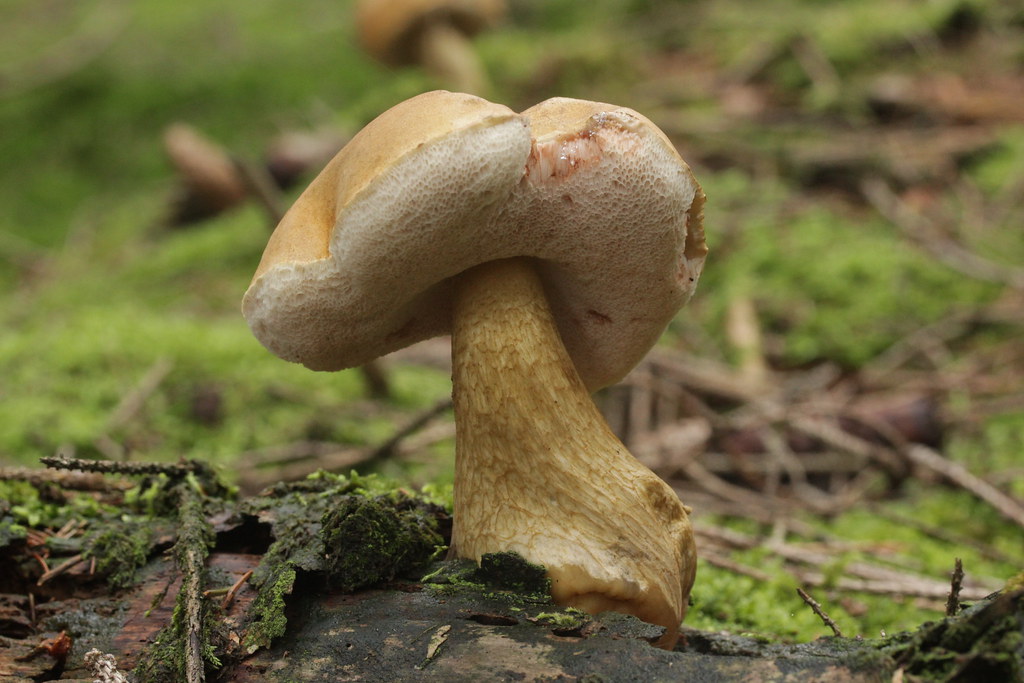
- Measuring 5–12 cm across, it begins as a hemispherical shape before flattening. The surface is pale brown to walnut-brown, initially downy or velvety and later becoming smooth or slightly greasy when moist.
- Stem
- 6–15 cm long and often club-shaped with a swollen base. The surface is cream to ochre-brown, notably covered in a prominent, dark brown, coarse network of raised ridges.
- Pores
- Large and angular; initially white or cream, turning salmon to coral-pink as the mushroom matures and staining rusty-brown when bruised.
- Tubes
- Soft tissue that transitions from white to pinkish-brown or salmon as it ages.
- Flesh
- White to cream, but staining pinkish-buff or clay-pink particularly underneath the cap surface; soft in texture with an extremely bitter, bile-like taste.
- Spore print
- Clay-pink to vinaceous or brownish-pink.
Sporecast is better in the app
Plan ahead with 10-day forecasts, see what people are finding nearby, get photo IDs, and track your finds.
Edibility
Frequently mistaken for the edible Penny Bun (Boletus edulis), this species is distinguished by its pinkish pores and dark brown netting on the stem. While not poisonous, it is considered inedible because of its intense, bile-like bitterness which only increases when cooked. A single specimen can ruin an entire dish.
Misidentification can be fatal. Never eat a mushroom unless you're 100% sure. This information may be inaccurate. Always consult multiple sources.
Nutrient Source
EctomycorrhizalThis mushroom forms a mutually beneficial relationship with tree roots, helping the tree absorb nutrients from the soil in exchange for sugars from the tree.
Common Names
- Basque
- Onddo mingots
- Catalan
- Mataparent amarg
- Danish
- Galderørhat
- Dutch
- Bittere boleet
- English
- Bitter Bolete
- Finnish
- sappitatti
- French
- Bolet de fiel, Faux cèpe, Chicotin, Bolet amer, Bolet chicotin
- German
- Gallenröhrling
- Norwegian Bokmål
- gallerørsopp
- Norwegian Nynorsk
- gallerøyrsopp
- Spanish
- chupa sangre, chupasangre, hongo amargo, Boleto amargo, camaleón rojo
- Swedish
- gallsopp
- Welsh
- Cap Tyllog Chwerw
Synonyms
- Boletus alutarius
- Boletus alutarius
- Boletus felleus
- Boletus felleus
- Dictyopus felleus
- Rhodoporus alutarius
- Rhodoporus felleus
- Rhodoporus felleus
- Suillus alutarius
- Suillus felleus
- Tylopilus alutarius
- Tylopilus alutarius
- Tylopius alutarius