
Habitat
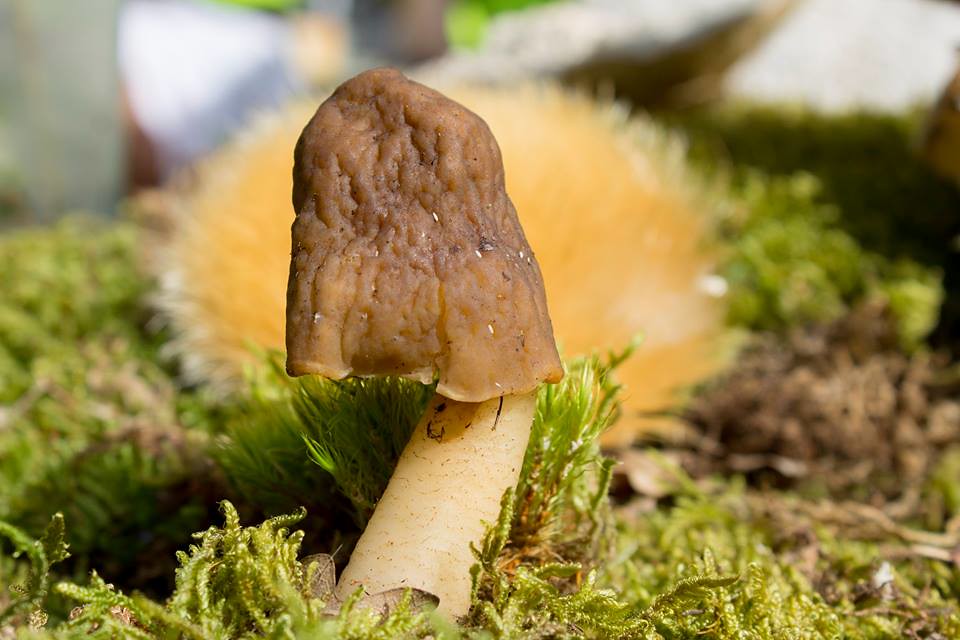
This mushroom typically grows on alkaline or chalky soils, often found in association with hawthorn in hedgerows and scrubland. It also inhabits moist areas such as path-sides, grassy spots, forest edges, and open woodlands. While European populations are frequently linked to broadleaf habitats, North American varieties are found in forest duff under both conifers and hardwoods, including cottonwood and oak trees.
Photos
Appearance
- Fruit body
- Rising 4–12 cm high, consisting of a distinct cap and stem.
- Cap
- 1.5–4 cm wide, bell-shaped, conical, or thimble-shaped. The margin is free from the stem, hanging like a pendant. Surface is typically smooth but can be irregularly wrinkled, furrowed, or finely cracked, ranging in color from ocher-brown and olive-brown to dark reddish-brown. The underside is pale buff or ochraceous and finely fuzzy.
- Stem
- 3–12 cm long and 0.5–2 cm thick, cylindrical to club-shaped. The surface is white, cream, or pale buff, characteristically decorated with brownish granules, fine scales, or chevrons often arranged in horizontal bands. It may be wrinkled or wavy.
- Flesh
- Thin and very fragile. The stem is initially stuffed with a cottony white pith but develops hollow pockets or becomes entirely hollow as it matures.
- Spore print
- Yellow to pale orange.
Sporecast is better in the app
Plan ahead with 10-day forecasts, see what people are finding nearby, get photo IDs, and track your finds.
Edibility
While some list this species as edible or even choice, others consider it possibly poisonous or not worth consuming. Some individuals have reported negative reactions after eating it. It can be confused with spring False Morels, though it is distinguished by a cap that hangs free from the stem and a stem that is stuffed with pith when young.
Misidentification can be fatal. Never eat a mushroom unless you're 100% sure. This information may be inaccurate. Always consult multiple sources.
Nutrient Source
otherIt is likely mycorrhizal, meaning it forms a symbiotic relationship with trees to obtain nutrients.
Common Names
- Danish
- Glat klokkemorkel
- Dutch
- Vingerhoedje
- English
- Thimble Morel, Conic Morel
- Finnish
- silokellomörsky
- French
- Verpe conique
- German
- Glockenverpel
- Norwegian Bokmål
- klokkemorkel
- Norwegian Nynorsk
- klokkemorkel
- Swedish
- klockmurkla
- Welsh
- Morel Pen Bys
Synonyms
- Helvella relhanii
- Leotia conica
- Monka conica
- Morchella agaricoides
- Morchella verpoides
- Phallus conicus
- Ptychoverpa conica
- Relhanum conicum
- Verpa morchellula
- Verpa relhanii
- Verpa relhanii