
Habitat
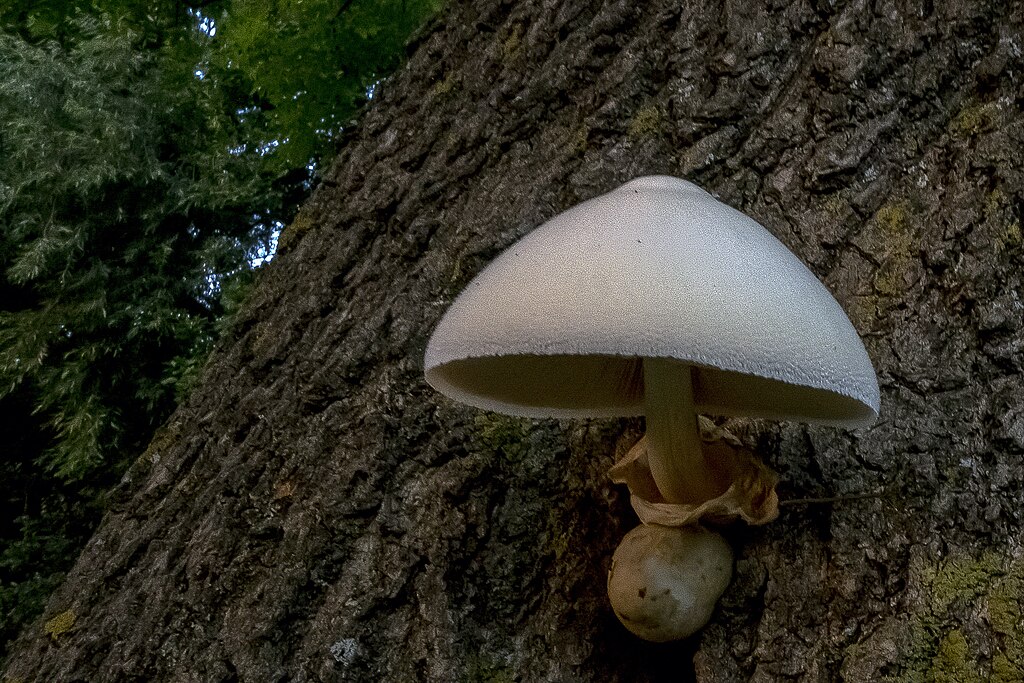
This wood-decomposing species grows on dead or living deciduous trees, including elm, beech, maple, oak, willow, and cottonwood. It is often found emerging from knot-holes, hollow trunks, cavities, wounds in standing timber, decaying logs, or stumps, and occasionally occurs on sawdust.
Photos
Appearance
- Cap
- 5–20 cm across; initially ovoid or egg-shaped, expanding to bell-shaped, convex, or flat with a broad central bump. The surface is dry, white to faintly yellowish, and densely covered in long, fine, silky fibers or hair-like scales.
- Gills
- Crowded and free from the stem; white when young, maturing to a flesh-pink, dull salmon, or brownish-pink color.
- Stem
- 2–20 cm long and 0.5–2 cm thick; often curved, tapering toward the top from a bulbous or enlarged base. The surface is white, smooth, or finely silky.
- Volva
- A prominent, bag-like, persistent membrane at the base of the stem; white to cream, often maturing to dingy brown or tan; may be slightly sticky.
- Flesh
- White, sometimes becoming faintly yellow; soft and fragile in the cap, fibrous in the stem.
- Spore print
- Pink, salmon, or brownish-pink.
- Scent and Taste
- Smell is described as pleasant, fresh, and sometimes resembling bean sprouts or having a radishy-musty quality; taste is mild or indistinct.
Sporecast is better in the app
Plan ahead with 10-day forecasts, see what people are finding nearby, get photo IDs, and track your finds.
Edibility
Possessing a mild flavor similar to bean sprouts or radishes, this mushroom has soft flesh and is considered a good edible. It bears a close resemblance to deadly Amanita species because of its white color and basal volva; however, its growth on wood and lack of a stem ring help distinguish it. Other similar small Volvariella species and the common Volvariella volvacea exist, while Pluteus tomentosulus can be distinguished by its lack of a volva.
Misidentification can be fatal. Never eat a mushroom unless you're 100% sure. This information may be inaccurate. Always consult multiple sources.
Nutrient Source
SaprotrophicIt obtains nutrients by breaking down dead organic matter, such as decaying wood from hardwood trees.
Common Names
- Basque
- kosko-ziza zetatsu, kosko-ziza zetatsua
- Danish
- Silkehåret posesvamp
- Dutch
- Zijdeachtige beurszwam
- English
- Silky Rosegill
- Finnish
- silkkituppisieni
- French
- Volvaire soyeuse
- German
- Wolliger Scheidling
- Norwegian Bokmål
- stor sliresopp
- Norwegian Nynorsk
- stor sliresopp
- Spanish
- volvaria sedosa
- Swedish
- silkesslidskivling
- Welsh
- Tagell Rosliw Sidanaidd
Synonyms
- Agaricus bombycina
- Agaricus bombycinus
- Agaricus denudatus
- Amanita bombycina
- Pluteus bombycinus
- Volvaria bombycina
- Volvaria flaviceps
- Volvariopsis bombycina