
Habitat
This species is found on soil in various woodland environments, parklands, and open areas. It grows solitarily or in groups, frequently appearing in grassy areas or along mossy banks near seasonal roads. It associates with a wide range of trees, including beech, larch, and cedar, as well as hardwoods like oak in North America. It is notable for its presence near isolated trees and its broad global distribution across temperate and subtropical regions.
Photos
Appearance
- Cap
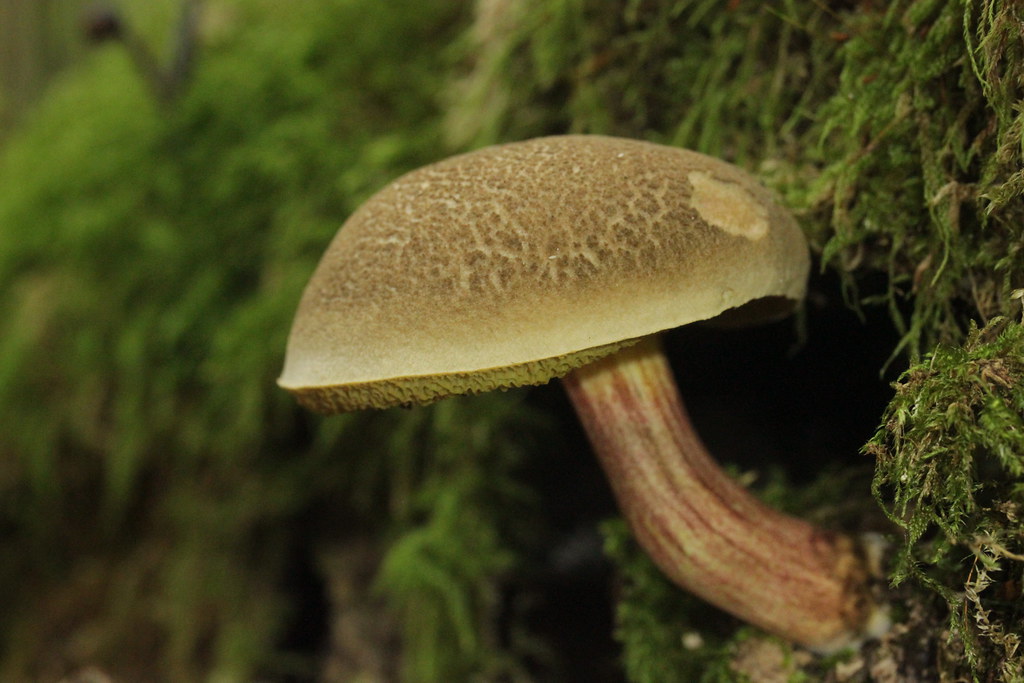
- 4–12 cm wide, initially hemispherical then flattened; olive-brown with reddish tints, surface is finely velvety then smooth, typically cracking to reveal pale yellow flesh that turns coral pink when damaged.
- Stem
- 4–10 cm long, slender and cylindrical or tapering upwards; yellow at the top and red below, often covered in dense reddish granules or streaks.
- Tubes
- Sulphur yellow, becoming depressed near the stem; they may bruise greenish or blue.
- Pores
- Large and angular, matching the yellow color of the tubes.
- Flesh
- Soft and straw-colored to yellow in the cap, becoming reddish-brown in the stem base; may slowly turn slightly blue when cut.
- Spore print
- Olive-green to brown.
Sporecast is better in the app
Plan ahead with 10-day forecasts, see what people are finding nearby, get photo IDs, and track your finds.
Edibility
This species has a soft texture with a faint, sometimes slightly sour taste. It can be difficult to distinguish from similar edible boletes, including Boletus edulis when young, as well as Xerocomellus truncatus and Boletellus intermedius, which may requires microscopic analysis of the spores to differentiate accurately.
Misidentification can be fatal. Never eat a mushroom unless you're 100% sure. This information may be inaccurate. Always consult multiple sources.
Nutrient Source
EctomycorrhizalThis mushroom forms a symbiotic relationship with trees, exchanging nutrients through their root systems.
Common Names
- Basque
- errementeriperretxiko, onto urregorria, errementi-perretxiko, onto urrehoria, onddo urregorri, errementeri-perrtxiko
- Catalan
- mataparent de carnog, mataparents, mataparent de carnoga, mataparent de carn groga
- Danish
- Rødsprukken rørhat
- Dutch
- Roodsteelfluweelboleet
- English
- Red Cracking Bolete, Red-Cracking Bolete, Red-cracking Bolete
- Finnish
- rusoruututatti
- French
- Bolet commun, Bolet à chair jaune
- German
- Rotfußröhrling
- Norwegian Bokmål
- ruterørsopp
- Norwegian Nynorsk
- ruterøyrsopp
- Spanish
- boleto de carne amarila, Boleto de carne amarilla
- Swedish
- rutsopp
- Welsh
- Cap Tyllog Craciog Coch
Synonyms
- Boletus briosianum
- Boletus chrysenteron — Red Cracking Bolete
- Boletus chrysenteron
- Boletus communis
- Ceriomyces communis
- Suillus chrysenteron
- Tylopilus sphagnorum
- Versipellis chrysenteron
- Xerocomus chrysenteron
- Xerocomus communis