
Habitat
This species grows on soil in mixed and broad-leaved woodlands, open parks, and near isolated trees. While it is particularly associated with oak, it also grows with a wide variety of other deciduous and coniferous trees.
Photos
Appearance
- Cap
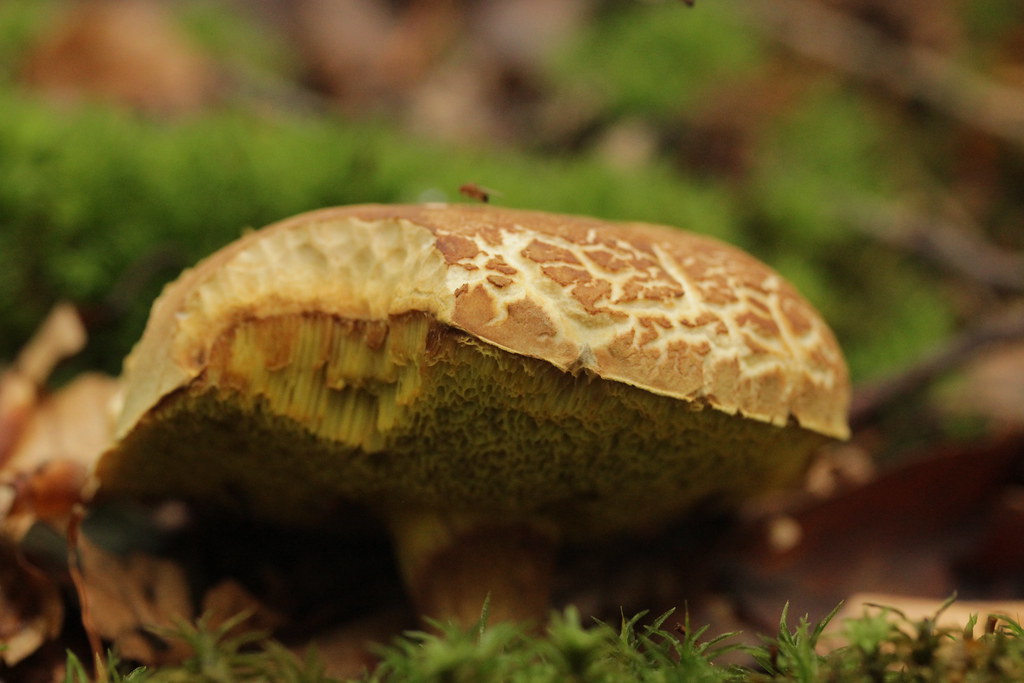
- Ranging from 2 to 8 cm wide, starting hemispherical and flattening with age; surface is dark olive-brown to cigar-brown, initially downy or velvety, and develops significant cracks that reveal yellowish or cream flesh underneath, especially toward the center.
- Stem
- Measuring 3 to 10 cm long, often slender or tapering upward; the apex is lemon-yellow while the lower portion is olivaceous-brown, sometimes featuring a reddish-brown zone and bruising dark or red-brown; surface may be faintly ribbed or streaked.
- Tubes
- Lemon-yellow maturing to olive-green; adnate and typically bruising blue.
- Pores
- Large, angular, and compound; matching the tube color (lemon-yellow to olive) and turning blue when bruised.
- Flesh
- Pale lemon-yellow to buff in the cap and chrome-yellow in the stem apex, becoming darker yellow or reddish-brown at the base; variable blueing reaction after cutting, most notably above the tubes.
- Spore print
- Olive-brown to olivaceous walnut-brown.
Sporecast is better in the app
Plan ahead with 10-day forecasts, see what people are finding nearby, get photo IDs, and track your finds.
Edibility
The flavor and scent of this species are not distinctive. It can be confused with other small boletes, though it can be distinguished by its specific color patterns and flesh that may turn blue when cut. Although listed as edible, it is not recommended for consumption.
Misidentification can be fatal. Never eat a mushroom unless you're 100% sure. This information may be inaccurate. Always consult multiple sources.
Nutrient Source
EctomycorrhizalIt forms a symbiotic relationship with trees, exchanging nutrients and water with the tree's root system.
Common Names
- Danish
- Hvidsprukken rørhat
- Dutch
- Sombere fluweelboleet
- English
- Sepia Bolete
- Finnish
- valeruututatti
- French
- Bolet fissuré
- Norwegian Bokmål
- blek ruterørsopp
- Norwegian Nynorsk
- bleik ruterøyrsopp
- Swedish
- falsk rutsopp
- Welsh
- Cap Tyllog Llwydfrown
Synonyms
- Boletus porosporus
- Boletus porosporus
- Boletus porosporus — Sepia Bolete
- Xerocomus porosporus
- Xerocomus porosporus