
Habitat
Occurs on the ground or in duff, typically found in broad-leaved, deciduous, or mixed woodlands and parklands. It is frequently associated with hardwoods such as oak and tanoak, but also grows in coniferous forests. This species can be found growing solitarily, in scattered clusters, or in small trooping groups.
Photos
Appearance
- Cap
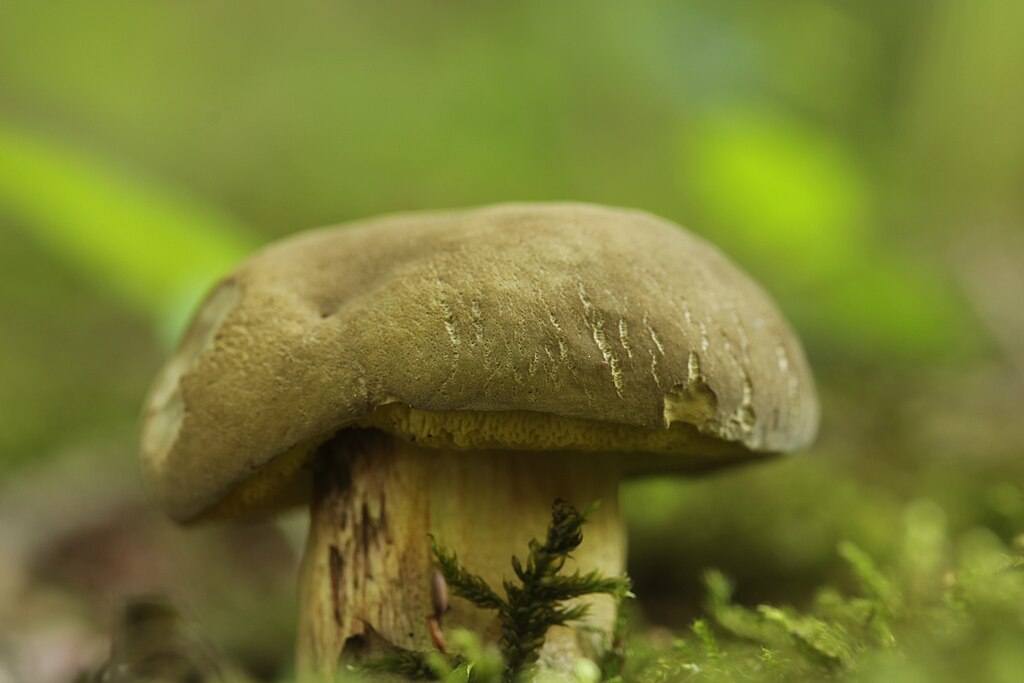
- 4–15 cm wide; initially hemispherical or convex, becoming flat or wavy with age. The surface is dry, velvety, or suede-like, colored olive-brown, yellow-brown, or reddish-brown. It often develops cracks that may reveal the yellow flesh beneath.
- Stem
- 3–12 cm long and 1–3 cm thick; slender, cylindrical, or tapering toward the base. It is pale yellow or yellowish-brown, often featuring reddish-brown longitudinal streaks, faint ribs, or a weak network (reticulum) near the top. The base is often attached to yellow fungal threads (rhizomorphs).
- Tubes
- Bright yellow or chrome yellow, maturing to olive-green or ochre-brown. They are attached to the stem, sometimes slightly running down it or sunken around it.
- Pores
- Large and angular; bright yellow maturing to a duller yellow or olive-brown. They may bruise slowly and faintly blue or green when damaged.
- Flesh
- Soft and pale yellow, whitish, or ivory. It may feature a purplish line just under the cap skin and pinkish-brown tones in the stem base. It usually does not change color when cut, though it occasionally stains slightly blue.
- Spore print
- Olive-brown to dull brown.
Sporecast is better in the app
Plan ahead with 10-day forecasts, see what people are finding nearby, get photo IDs, and track your finds.
Edibility
This mushroom has a mild, fruity or mushroomy smell and a mild or bland taste. It is easily confused with a variety of other small, edible boletes, including Aureoboletus and Xerocomus spadiceus. The flesh and bright yellow pores may slowly turn blue or greenish when bruised or damaged.
Misidentification can be fatal. Never eat a mushroom unless you're 100% sure. This information may be inaccurate. Always consult multiple sources.
Nutrient Source
EctomycorrhizalIt forms a symbiotic relationship with living trees by enveloping their underground roots with fungal tissue, exchanging nutrients with the tree.
Common Names
- Basque
- onto biguna, onddo bigun
- Danish
- Filtet rørhat
- Dutch
- Fluweelboleet
- English
- Brown And Yellow Bolete, Boring Brown Bolete, Yellow-cracked Bolete, Suede Bolete
- Finnish
- samettitatti
- French
- Bolet subtomenteux
- German
- Ziegenlippe, Goldgelber Filzröhrling
- Norwegian Bokmål
- sørlig fløyelsrørsopp
- Norwegian Nynorsk
- sørleg fløyelsrøyrsopp
- Spanish
- hongo afelpado, hongo blando, boleto subtomentoso
- Swedish
- sammetssopp
- Welsh
- Cap Tyllog Melfedaidd
Synonyms
- Boletus cinnamomeus
- Boletus crassipes
- Boletus cupreus
- Boletus dentatus
- Boletus eriophorus
- Boletus fuscus
- Boletus lanatus
- Boletus leguei
- Boletus pannosus
- Boletus striipes
- Boletus striipes
- Boletus subtomentosus — Suede Bolete
- Boletus xanthus
- Ceriomyces subtomentosus
- Leccinum subtomentosum
- Rostkovites subtomentosus
- Suillus lanatus
- Suillus leguei
- Suillus pannosus
- Suillus striipes
- Suillus subtomentosus
- Tubiporus subtomentosus
- Versipellis subtomentosa
- Xerocomopsis subtomentosa
- Xerocomus fuscus
- Xerocomus lanatus
- Xerocomus lanatus
- Xerocomus leguei
- Xerocomus leguei
- Xerocomus leguei
- Xerocomus marginalis
- Xerocomus striaepes
- Xerocomus subtomentosus
- Xerocomus xanthus
- Xerocomus xanthus