
Habitat
This common wood-decomposing fungus grows on the dead wood of broadleaf trees, and more rarely on conifers. It is frequently found on stumps, logs, and other woody debris, including buried wood. It typically grows in broadleaf or mixed broadleaf-conifer forests, often favoring alder. Fruiting bodies may appear solitary, in loose clusters, or in dense masses.
Photos
Appearance
- Fruit body
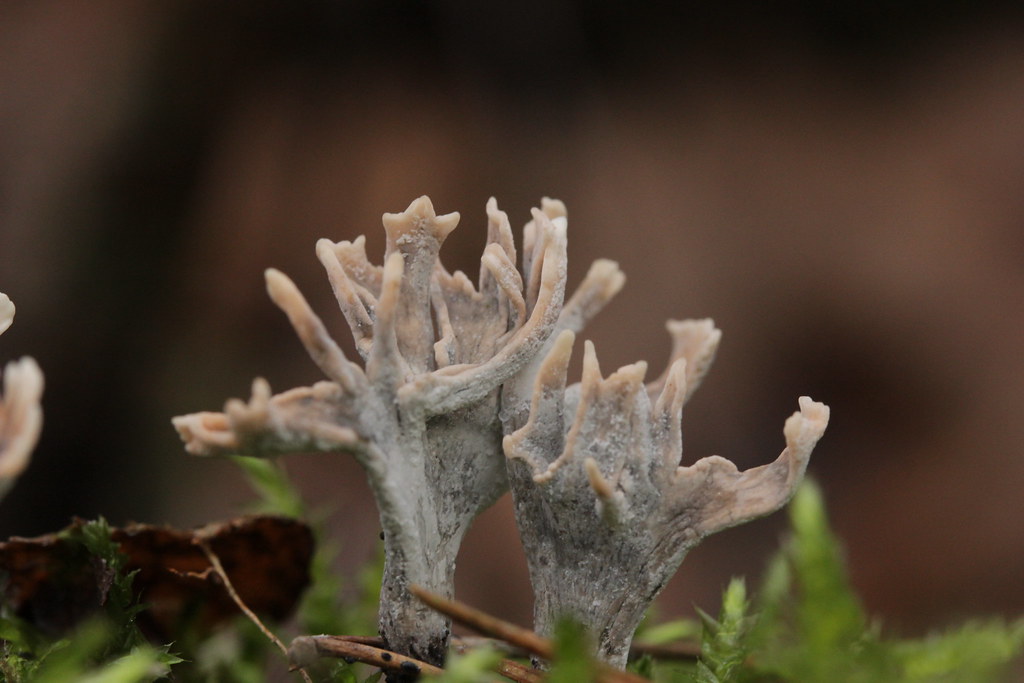
- Slender and erect, ranging from 1 to 12 cm tall; initially cylindrical or subcylindrical but typically becoming flattened and forking into antler-like branches at maturity.
- Color
- The base and lower portion are black, while the upper branches are initially covered in a powdery white or gray coating. As it matures, the branches turn gray and eventually become entirely black.
- Surface
- The lower portion is often hairy or velvety. Older specimens become warty, pimply, or roughened due to the development of embedded spore-producing structures.
- Flesh
- Tough, wiry, or rubbery in texture; brittle when old. The interior is white to pale gray, eventually turning black with age.
- Spore print
- Black or blackish.
Sporecast is better in the app
Plan ahead with 10-day forecasts, see what people are finding nearby, get photo IDs, and track your finds.
Edibility
The texture of this fungus is notably thin, tough, and wiry, becoming brittle with age; one source suggests it is too tough to be of interest for consumption. While some sources list its edibility as unknown, others specifically identify it as not edible. The taste and odor of the flesh are described as indistinct or not distinctive.
Misidentification can be fatal. Never eat a mushroom unless you're 100% sure. This information may be inaccurate. Always consult multiple sources.
Nutrient Source
SaprotrophicIt obtains nutrients by decomposing dead organic matter such as wood and bark.
Common Names
- Basque
- kimo adarzuri
- Danish
- Grenet stødsvamp
- Dutch
- Geweizwam
- English
- Candle-Snuff Fungus, Candlesnuff Fungus
- Finnish
- haarasarvisieni
- French
- Xylaire du bois
- German
- Geweihförmige Holzkeule
- Norwegian
- hornsopp, finger-sopp, kjønrøk-sopp
- Norwegian Bokmål
- stubbehorn
- Norwegian Nynorsk
- stubbehorn
- Spanish
- Xilaria de la madera, cerillas
- Swedish
- stubbhornssvamp, stubbhorn
- Welsh
- Cyrn Gwyn
Synonyms
- Clavaria hypoxylon
- Cordyceps hypoxylon
- Cordylia hypoxylon
- Sphaeria adscendens
- Sphaeria cupressiformis
- Sphaeria hypoxylon
- Sphaeria ramosa
- Xylaria adscendens
- Xylaria cornuta
- Xylaria cupressiformis
- Xylaria subtrachelina
- Xylaria xypoxylon
- Xylosphaera adscendens
- Xylosphaera hypoxylon