
Habitat
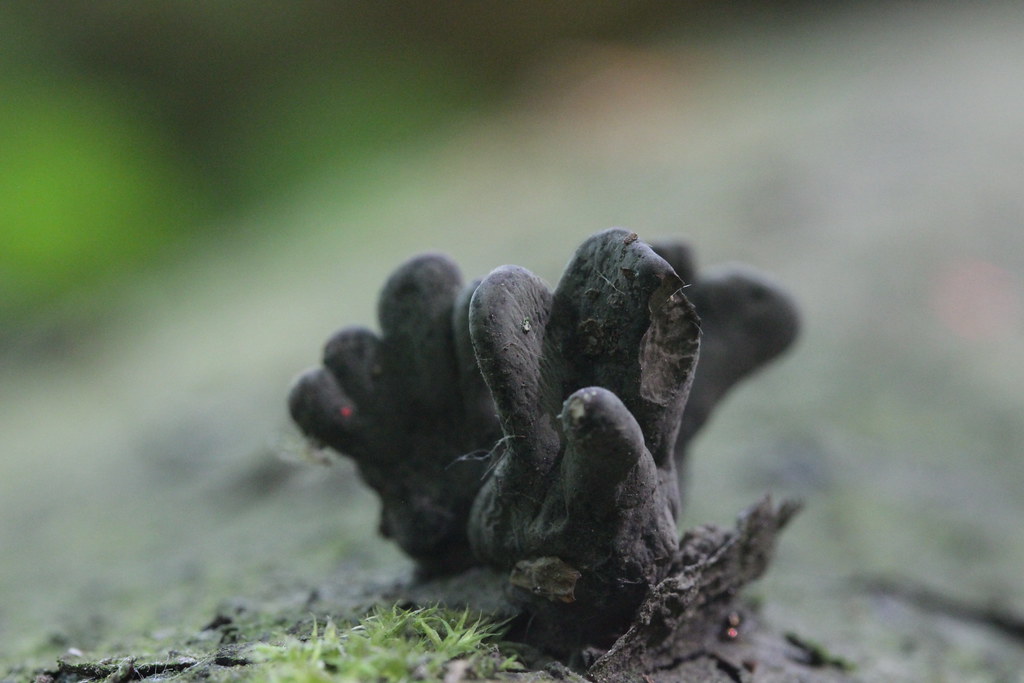
This wood-decomposing species grows in small to large clusters or tufts on the stumps, logs, and roots of broad-leaved trees. It is particularly common on beech and is typically found at or near ground level.
Photos
Appearance
- Fruit body
- Irregularly club-shaped or cylindrical structure reaching 2 to 10 cm in height and 1 to 3 cm in width. The surface is roughened, finely wrinkled, or cracked, resembling a crust. Color starts powdery white or gray when young, maturing to black.
- Stem
- A short, stout, and cylindrical stalk that is sometimes velvety at the base and smoother toward the top. It is typically brownish-black and tapers into the main body.
- Flesh
- Tough and pure white, providing a sharp contrast to the dark exterior. A cross-section reveals black, spore-producing cavities embedded just beneath the surface crust.
- Spore print
- Dark brown to black.
Sporecast is better in the app
Plan ahead with 10-day forecasts, see what people are finding nearby, get photo IDs, and track your finds.
Edibility
This species is considered inedible due to its very tough, wood-like flesh. It is similar in appearance to Xylaria longipes, which typically grows on maple or sycamore, and Xylaria cubensis, though the latter can be distinguished by significantly smaller spores.
Misidentification can be fatal. Never eat a mushroom unless you're 100% sure. This information may be inaccurate. Always consult multiple sources.
Nutrient Source
facultativeThis fungus obtains nutrients by breaking down dead woody plant material, and can also act as a weak parasite on stressed trees.
Common Names
- Basque
- kimo formanitz
- Danish
- Kølle-stødsvamp
- Dutch
- Houtknotszwam
- English
- Dead Man's Fingers
- Finnish
- nuijasarvisieni
- French
- Xylaire polymorphe, Doigt de Satan, Doigt du mort
- German
- Vielgestaltige Holzkeule
- Norwegian Bokmål
- bredt stubbehorn
- Norwegian Nynorsk
- breitt stubbehorn
- Spanish
- Xilaria polimorfa
- Swedish
- mångformig stubbsvamp, tjockhorn
- Welsh
- Bysedd y Meirw
Synonyms
- Cordyceps polymorpha
- Cordylia polymorpha
- Hypoxylon polymorphum
- Sphaeria digitata
- Sphaeria polymorpha
- Xylaria clavata
- Xylaria corrugata
- Xylaria rugosa
- Xylosphaera polymorpha
- Xylosphaeria polymorpha