
Habitat
Woodland
Grows on the stumps and logs of deciduous trees, with a strong preference for elm and ash. It typically appears in large tiers or groups on dead wood, though it is occasionally found on living trees.
Photos
Appearance
- Fruit body
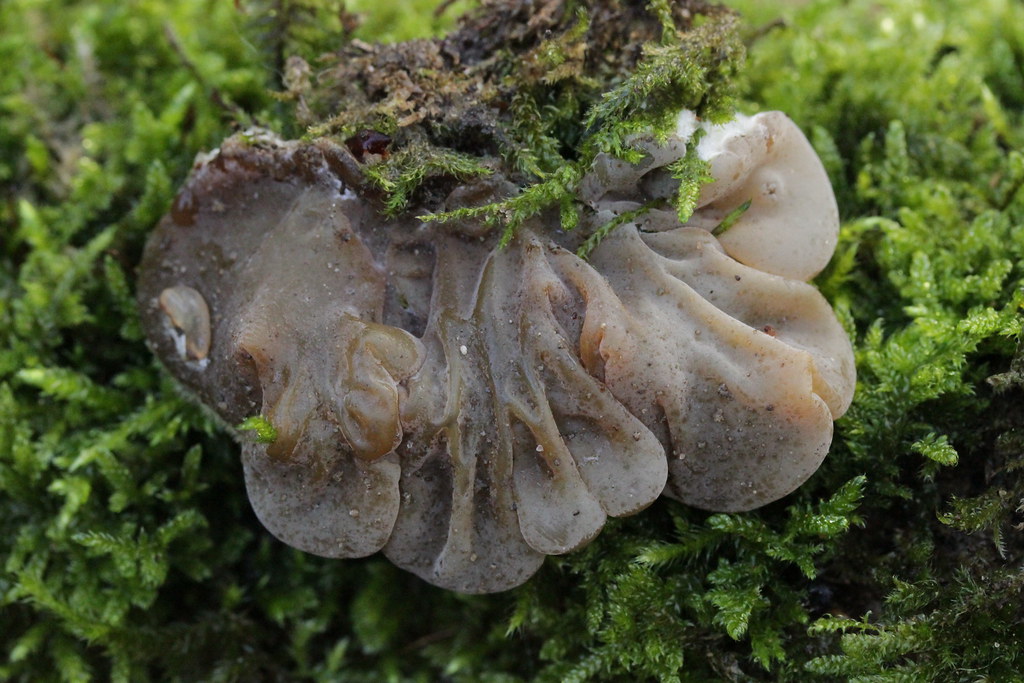
- Initially disc-shaped, becoming irregularly shaped and forming tiered, bracket-like structures that are loosely attached to the wood; typically 1 to 8 centimeters wide.
- Upper surface
- Characterized by concentrated zones of grey to grey-brown color with a paler, lobed margin; covered in soft or downy hairs.
- Lower surface
- Reddish-purple to dark purple with a white powdery bloom; the texture is coarsely wrinkled or wavy.
- Flesh
- Brownish color with a rubbery, elastic, and gelatinous consistency; becomes hard and brittle when dehydrated.
- Spore print
- White.
Sporecast is better in the app
Plan ahead with 10-day forecasts, see what people are finding nearby, get photo IDs, and track your finds.
Edibility
Not edible
The flesh has a tough, rubbery, and gelatinous texture that becomes hard and brittle when dry. The flavor is described as mild and indefinite.
Misidentification can be fatal. Never eat a mushroom unless you're 100% sure. This information may be inaccurate. Always consult multiple sources.
Nutrient Source
SaprotrophicIt obtains nutrients by breaking down dead wood from deciduous trees and shrubs.
Common Names
- Basque
- mukibelarri zonatu
- Danish
- Håret judasøre
- Dutch
- Viltig judasoor
- English
- Tripe Fungus
- French
- Oreille poilue
- German
- Gezonter Ohrlappenpilz
- Norwegian Bokmål
- skrukkeøre
- Norwegian Nynorsk
- skrukkeøyre
- Swedish
- svartöra
- Welsh
- Clustiau'r Llwyfen
Synonyms
- Auricularia corrugata
- Auricularia lobata
- Auricularia mesenterica
- Auricularia mesenteriformis
- Auricularia pusio
- Auricularia tremelloides
- Dacrymyces violaceus
- Exidia lobata
- Exidia lobata
- Gyraria violacea
- Helvella mesenterica
- Helvella mesenterica
- Merulioporia violacea
- Meruliopsis violacea
- Merulius mesentericus
- Patila mesenterica
- Phalloboletus tremelloides
- Phlebia mesenterica
- Stereum mesentericum
- Thelephora mesenterica
- Thelephora mesenterica
- Thelephora tremelloides
- Tremella corrugata
- Tremella violacea
- Tremella violacea