
Habitat
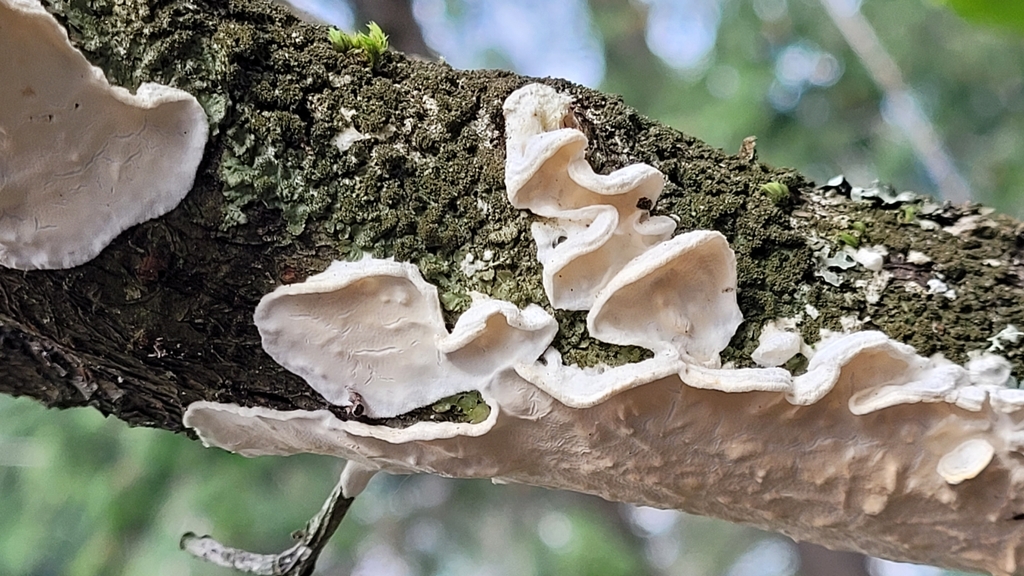
This common white-rot fungus typically thrives on the bark and dead wood of deciduous trees and shrubs, particularly ash, though it occasionally occurs on conifers. It is most frequently found attached to the undersides of small fallen twigs and horizontal branches, forming spreading, leathery sheets.
Photos
Appearance
- Fruit body
- Forms spreading, irregular patches that are initially flat against the wood, often developing narrow, shelf-like caps that project up to 2 cm. The surface is fibrous to woolly, sometimes zoned, with margins that appear hairy or fringed.
- Pores
- The underside begins smooth and white, maturing into a warty or net-like surface with shallow, irregular pits. Color shifts from white to pinkish-tan, yellowish, or orange.
- Flesh
- Whitish, very thin, and pliant with a leathery or tough texture.
- Spore print
- White.
Sporecast is better in the app
Plan ahead with 10-day forecasts, see what people are finding nearby, get photo IDs, and track your finds.
Edibility
This species has a leathery, tough physical texture and thin flesh. It may be confused with Jelly Rot (Phlebia tremellosa), though that species typically displays deeper orange upper surfaces and larger, radiating, pink-orange false pores on its underside.
Misidentification can be fatal. Never eat a mushroom unless you're 100% sure. This information may be inaccurate. Always consult multiple sources.
Nutrient Source
SaprotrophicIt obtains nutrients by decomposing dead organic matter.
Common Names
- Danish
- Læder-åresvamp
- Dutch
- papierzwammetje, Papierzwammetje
- English
- Netted Crust
- Finnish
- kelmukka
- French
- Mérule papyracée
- German
- Lederartiger Fältling
- Norwegian Bokmål
- blek nettsopp
- Norwegian Nynorsk
- bleik nettsopp
- Swedish
- pappersgröppa
- Welsh
- Crawen Ledraidd
Synonyms
- Auricularia papyrina
- Boletus cellulosus
- Boletus purpurascens
- Byssomerulius confluens
- Byssomerulius sordidus
- Cantharellus confluens
- Cladoderris rickii
- Meruliopsis corium — Netted Crust
- Merulius aurantiacus
- Merulius aurantiacus
- Merulius chilensis
- Merulius confluens
- Merulius corium
- Merulius cubensis
- Merulius deglubens
- Merulius dubiosus
- Merulius dubiosus
- Merulius haedinus
- Merulius hirsutus
- Merulius moelleri
- Merulius papyrinus
- Merulius pelliculosus
- Merulius sodiroi
- Merulius sordidus
- Merulius sordidus
- Merulius stereoides
- Merulius ulmi
- Microporus eriophorus
- Phlebia blumenaviensis
- Phlebia deglubens
- Phlebia deglubens
- Phlebia sodiroi
- Polyporus eriophorus
- Polyporus purpurascens
- Polystictus eriophorus
- Sesia aurantiaca
- Sesia confluens
- Sesia corium
- Sesia haedina
- Thelephora corium
- Thelephora papyrina