
Habitat
Mainly found in pastureland, meadows, and along grassy roadsides. It also appears on heathland, at the edges of woods, and occasionally near trees. While it grows on soil in various environments, it shows a preference for chalk or limestone soils. It typically grows in groups or classic fairy rings, though it occurs less frequently as solitary specimens.
Photos
Appearance
- Cap
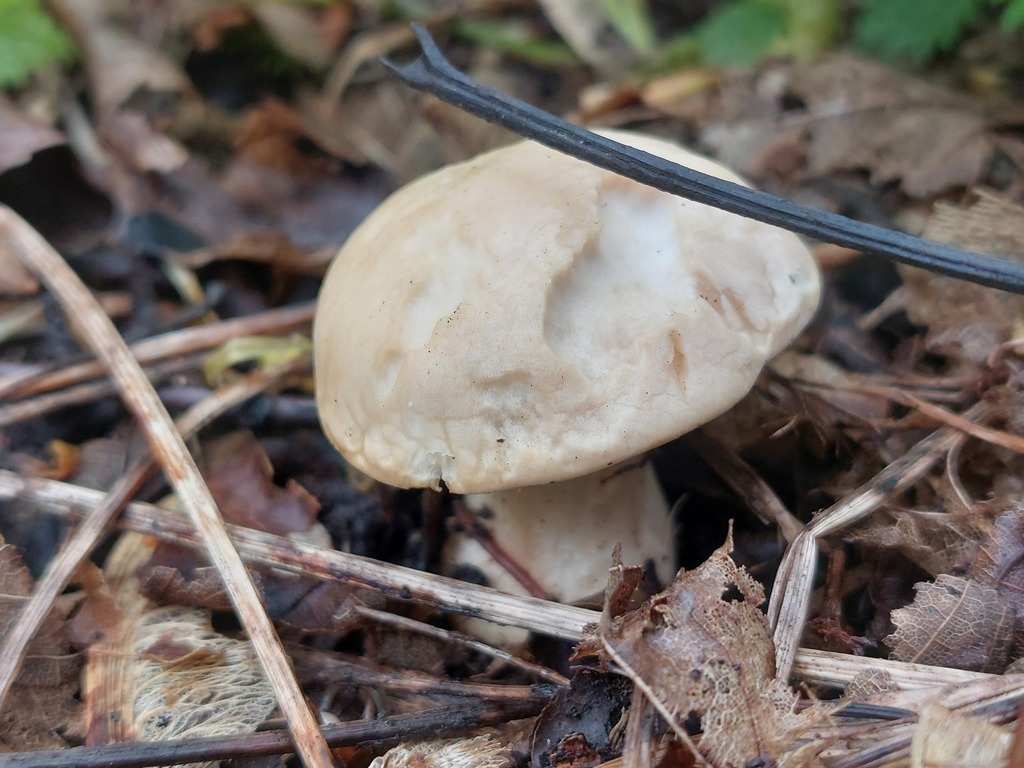
- 4–15cm wide; initially rounded or subglobose, later expanding to become flattened or irregularly wavy; surface is smooth, silky, or cracked; the margin remains slightly inrolled; color ranges from white to cream.
- Stem
- 2–8cm long, 10–25mm thick; stout and smooth, sometimes tapering upwards or featuring a bulbous base; white to cream, occasionally showing a marbled effect.
- Gills
- Narrow and very crowded; emarginate; white to cream in color.
- Flesh
- Thick, soft, and white to cream; sometimes has a marbled appearance; does not change color when cut.
- Spore print
- White.
- Odour and Taste
- Distinctive and strong; described as floury, mealy, or similar to melon rind.
Sporecast is better in the app
Plan ahead with 10-day forecasts, see what people are finding nearby, get photo IDs, and track your finds.
Edibility
This mushroom has a soft texture and a strong, distinctive flavor described as floury, mealy, or similar to melon rind. Foragers must exercise great caution as it can be confused with the dangerously poisonous Livid Pinkgill, which also fruits in spring and has a mealy smell, and deadly white Clitocybe species that may grow in the same habitat. While considered a delicacy, some people find the taste overpowering.
Misidentification can be fatal. Never eat a mushroom unless you're 100% sure. This information may be inaccurate. Always consult multiple sources.
Nutrient Source
SaprotrophicThis species obtains nutrients by breaking down dead organic matter in the soil, such as decaying plant material.
Common Names
- Danish
- Vårmusseron
- Dutch
- Voorjaarspronkridder
- English
- St George's Mushroom, St. George's Mushroom
- Finnish
- kevätkaunolakki
- French
- Mousseron de la Saint-Georges, Tricholome de la Saint-Georges
- German
- Mairitterling
- Norwegian
- geit-sopp
- Norwegian Bokmål
- vårfagerhatt
- Norwegian Nynorsk
- vårfagerhatt
- Swedish
- vårmusseron, Vårmusseron
- Welsh
- Pengrwm Calan Mai
Synonyms
- Agaricus albellus
- Agaricus aromaticus
- Agaricus gambosus
- Agaricus gambosus
- Agaricus georgii
- Agaricus georgii
- Amanita georgii
- Calocybe gambosa — St. George's Mushroom
- Calocybe georgii
- Calocybe georgii
- Gyrophila georgii
- Gyrophila palumbina
- Lyophyllum gambosum
- Lyophyllum georgii
- Tricholoma gambosum
- Tricholoma georgii
- Tricholoma graveolens
- Tricholoma mouceron
- Tricholoma palumbinum