
Habitat
Occurs on soil in broad-leaved and mixed forests, showing a preference for beech trees. It is frequently found growing among moss along the edges of paths, appearing either as solitary specimens or in small, somewhat tufted clusters.
Photos
Appearance
- Cap
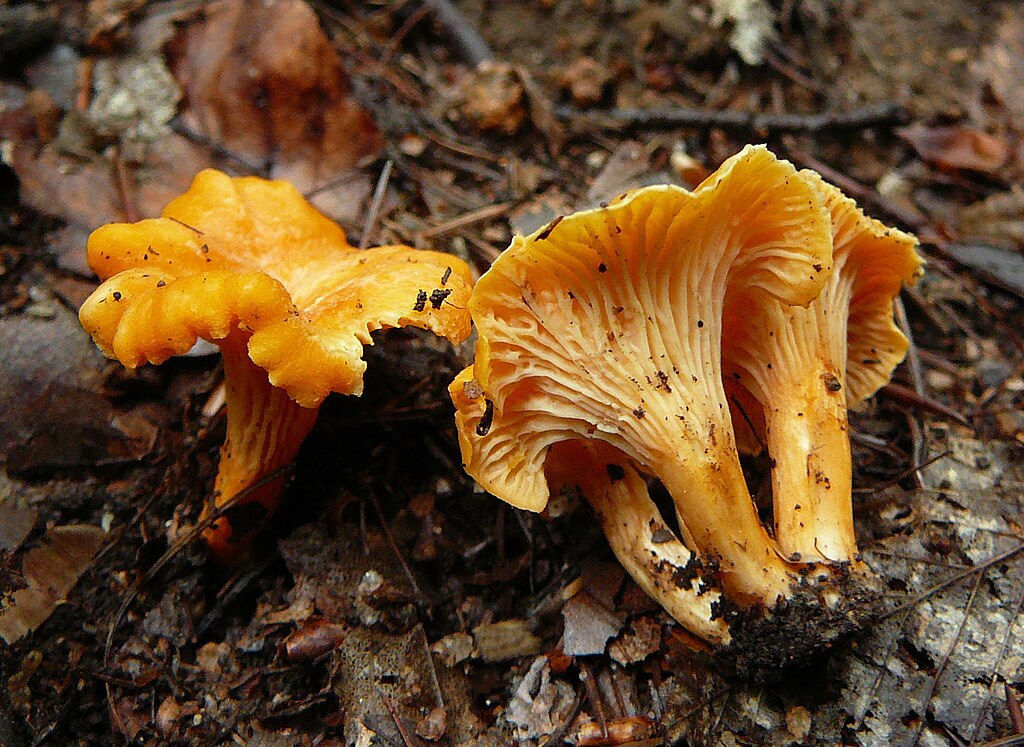
- Measures 1.5 to 4.5 cm wide; starts slightly convex but quickly becomes funnel-shaped and centrally depressed; shiny, smooth surface with a pale, wavy margin.
- Stem
- Short and sturdy, reaching 1 to 3 cm in height; texture ranges from smooth to finely velvety with white fuzz at the base.
- Gills
- Consists of shallow, irregularly branching ridges that run down the stem; colored pale yellow, occasionally showing a pinkish tint.
- Flesh
- Pale orange inside the cap and yellowish-white within the stem.
- Spore print
- Pale cream.
Sporecast is better in the app
Plan ahead with 10-day forecasts, see what people are finding nearby, get photo IDs, and track your finds.
Edibility
This species is frequently confused with Cantharellus cibarius, though it features paler ridges and more elongated spores. The flavor is described as somewhat bitter or acrid, while the aroma is a subtle pleasant or fruity scent.
Misidentification can be fatal. Never eat a mushroom unless you're 100% sure. This information may be inaccurate. Always consult multiple sources.
Nutrient Source
EctomycorrhizalIt forms a symbiotic relationship with trees, exchanging nutrients through the root system.
Common Names
- English
- Orange Chanterelle
- French
- Girolle abricot
- German
- Samt-Pfifferling
- Norwegian Bokmål
- oransjekantarell
- Norwegian Nynorsk
- oransjekantarell
- Swedish
- orange kantarell
- Welsh
- Siantrel Melyngoch
Synonyms
- Craterellus friesii
- Merulius friesii