
Habitat
This species prefers nutrient-rich soil and thick leaf litter or duff. It is commonly found in gardens, parks, compost heaps, and urban settings, as well as under hedges and in dark woodland areas. It frequently associates with specific trees such as Monterey Cypress, eucalyptus, acacia, oak, and pine. Growth patterns include solitary fruiting, pairs, fused clumps, arcs, large troops, or fairy rings.
Photos
Appearance
- Cap
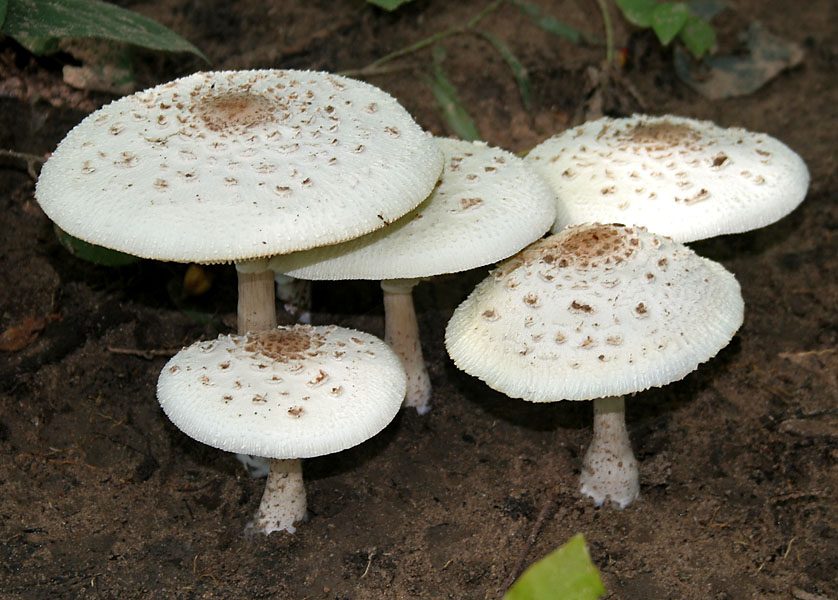
- 5 to 20 cm wide; initially spherical or blocky and cinnamon-brown, expanding to convex or flat. The brown surface breaks into large, flat, difficult-to-detach scales on a shaggy white to beige fibrous background, though the center remains solid brown. The edge sometimes features a whitish fringe of hanging fibers.
- Stem
- 7 to 25 cm long and up to 3 cm thick at the top; smooth and white to tan, bruising reddish-brown. The base features an abrupt, flattened, bulbous base that often has an upturned, gutter-like rim. It lacks the snakeskin-like pattern found in some other parasol species and is hollow in the center.
- Gills
- Free from the stem, crowded, and broad. Initially white, they turn dull beige or brown with age and may develop orange or brown bruising. A faint blue-green tint may occasionally appear near the stem.
- Flesh
- White to pale creamy-beige, firm and fibrous. When cut or bruised, it quickly turns orange, then dingy red, and eventually brown.
- Ring
- Large, persistent, and often movable. It is thin but tenacious with a double-lipped or spiky-shaggy edge; the upper surface is white while the underside may show brown patches.
- Spore print
- White.
- Odour and Taste
- Smell is pleasantly savory or earthy when fresh, becoming musty with age. Taste is mild and pleasant.
Sporecast is better in the app
Plan ahead with 10-day forecasts, see what people are finding nearby, get photo IDs, and track your finds.
Edibility
This mushroom has a mild, savory, or earthy flavor but must be cooked thoroughly before consumption. It is known to cause severe gastrointestinal distress in some individuals, including those who have previously eaten it without issue; limit intake to small quantities and use only fresh caps. Be aware that the species can accumulate heavy metals from its environment and can be confused with the poisonous Chlorophyllum molybdites, which is distinguished by its green spores and gills.
Misidentification can be fatal. Never eat a mushroom unless you're 100% sure. This information may be inaccurate. Always consult multiple sources.
Nutrient Source
SaprotrophicIt obtains nutrients by breaking down dead organic matter in soil, such as dead leaves and wood.
Common Names
- Danish
- Giftig rabarberhat
- Dutch
- Bruine knolparasolzwam
- English
- Brown Parasol
- Finnish
- tarha-akansieni
- French
- Lépiote vénéneuse
- German
- Garten-Riesenschirmling
- Norwegian Bokmål
- lumsk parasollsopp, lumsk rødnende parasollsopp
- Norwegian Nynorsk
- lumsk raudnande parasollsopp, lumsk parasollsopp
- Swedish
- parkfjällskivling
Synonyms
- Lepiota bohemica
- Lepiota brunnea
- Lepiota rhacodes
- Macrolepiota bohemica
- Macrolepiota brunnea