
Habitat
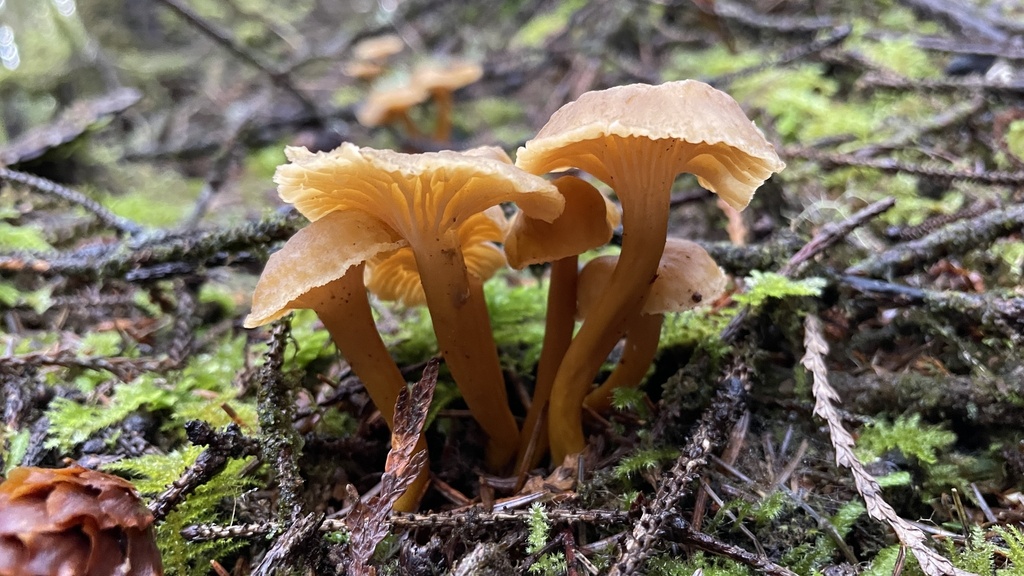
This common chanterelle is found on the ground in both coniferous and deciduous woodlands, though it often shows a strong preference for conifer forests, especially those containing western hemlock, Douglas-fir, or Sitka spruce. It frequently grows on acid soils, needle duff, or among mosses such as Sphagnum. It is also commonly found on or around well-decayed, moss-covered logs, stumps, and coarse woody debris, as well as in conifer bogs and areas with bracken. It typically fruits in large groups, clumps, or troops.
Photos
Appearance
- Cap
- 1.5–8 cm wide; convex with a small central dimple when young, becoming deeply depressed, funnel-shaped, or trumpet-like with age; center often perforated and continuous with the hollow stem. The color is dark dingy brown to yellowish-brown, sometimes fading to grey or exhibiting orange-yellow tints at the wavy, lobed, or wrinkly-ruffled margin. The surface is dry, smooth, or slightly scaly.
- Gills
- Decurrent, shallow, and ridge-like rather than true gills; they are widely spaced, blunt, and irregularly forked with cross-veins. Color varies from yellowish or orange-beige to light grey or pale lilac-grey, often contrasting with the stem.
- Stem
- 2–12 cm long and 3–15 mm thick; typically bright yellow, orange-yellow, or dingy yellow, often fading to greyish-yellow or becoming whitish at the base. The shape is often flattened, twisted, or irregularly grooved; it is smooth and initially stuffed but becomes characteristically hollow and tubular.
- Flesh
- Thin, pliable, and rubbery in the cap; yellowish to white. The stem flesh is cartilaginous.
- Spore print
- White to pale yellowish or cream.
- Odor
- Faint and indistinct, though sometimes described as aromatic or pleasantly spicy and fruity.
- Taste
- Mild to slightly bitter when raw; indistinct.
Sporecast is better in the app
Plan ahead with 10-day forecasts, see what people are finding nearby, get photo IDs, and track your finds.
Edibility
The taste of this mushroom varies from mild and indistinct to slightly bitter or aromatic, with thin, pliable cap flesh and a hollow, cartilaginous stem. While it is generally considered a choice edible that is easy to clean, foragers should distinguish it from the similar-looking Jelly Babies (Leotia lubrica), which lacks gill-like wrinkles, and Goldgill Navelcaps or Xeromphalina species, which have true gills rather than blunt ridges. Other similar species include Craterellus sphaerosporus, C. pallidipes, and C. flavobrunneus, all of which are documented as safe to eat.
Misidentification can be fatal. Never eat a mushroom unless you're 100% sure. This information may be inaccurate. Always consult multiple sources.
Nutrient Source
EctomycorrhizalIt forms a symbiotic relationship with trees, exchanging nutrients between the tree's roots and the soil.
Common Names
- Basque
- saltsa-perretxiko horilun
- Danish
- Tragt-kantarel
- Dutch
- Trechtercantharel
- English
- Yellowfoot, Trumpet Chanterelle, Yellowlegs, Winter Chanterelle
- Finnish
- suppilovahvero
- French
- Chanterelle d'Automne, Chanterelle en Tube, Chanterelle Modeste, Chanterelle Grise
- German
- Trompeten-Pfifferling, Durchbohrter Leistling
- Latvian
- Zeltkāta Gailene
- Norwegian Bokmål
- traktkantarell
- Norwegian Nynorsk
- trektkantarell
- Polish
- Pieprznik Trąbkowy
- Spanish
- rebozuelo atrompetado, trompeta amarillan pliegues, tronpeta horiluna
- Swedish
- trattkantarell
- Welsh
- Siantrel Cornffurf
Synonyms
- Agaricus cantharelloides
- Agaricus cantharelloides
- Agaricus pruinatus
- Cantharellus cantharelloides
- Cantharellus infundibuliformis
- Cantharellus tubaeformis — Trumpet Chanterelle
- Cantharellus xanthopus
- Chanterel infundibuliformis
- Craterellus cantharelloides
- Craterellus xanthopus
- Helvella cantharelloides
- Helvella tubaeformis
- Helvella tubiformis
- Hyponevris pruinata
- Merulius cantharelloides
- Merulius cantharelloides
- Merulius fuligineus
- Merulius helvelloides
- Merulius infundibularis
- Merulius infundibuliformis
- Merulius lutescens
- Merulius pruinatus
- Merulius tubiformis
- Merulius villosus
- Merulius xanthopus
- Peziza undulata
- Trombetta lutescens