
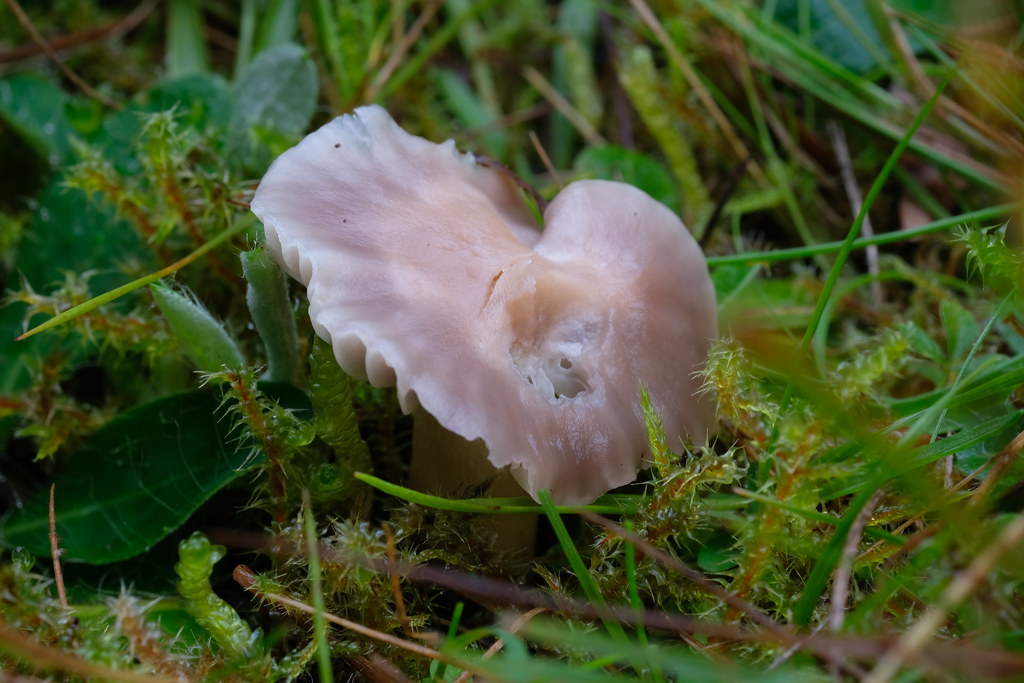
Habitat
Grassland
Occurs on soil within short turf in semi-improved or unimproved grasslands. It can be found growing individually or in small, scattered groups.
Photos
Appearance
- Cap
- 1.5 to 4 cm wide; initially convex, becoming flat with a slight central hump; surface is slightly greasy in wet conditions and lightens as it dries, featuring visible lines at the edge.
- Stem
- 3 to 5 cm long and mostly uniform in thickness, though it tapers at the very bottom; characterized by a yellow base.
- Gills
- Gray-violet in color, spaced relatively far apart, and attached to the stem while slightly running down it; veins are connected between the gills.
- Flesh
- Grayish-white.
- Spore print
- White.
Sporecast is better in the app
Plan ahead with 10-day forecasts, see what people are finding nearby, get photo IDs, and track your finds.
Edibility
unknown
Misidentification can be fatal. Never eat a mushroom unless you're 100% sure. This information may be inaccurate. Always consult multiple sources.
Nutrient Source
facultativeIt is believed to derive nutrients from plant matter, possibly through associations with mosses or through absorption of recent photosynthate from plants, rather than decomposing dead organic matter.
Common Names
- Danish
- Gulfodet vokshat
- Dutch
- Geelvoetwasplaat
- English
- Yellow Foot Waxcap
- Swedish
- lila vaxskivling, lilavaxing
- Welsh
- Cap Cŵyr Troed Melyn
Synonyms
- Camarophyllus flavipes
- Hygrocybe flavipes
- Hygrocybe flavipes — Yellow Foot Waxcap
- Hygrophorus flavipes