
Habitat
This species occurs on soil in parklands and along roadsides, specifically associating with poplar or lime trees. It typically grows in small groups.
Photos
Appearance
- Cap
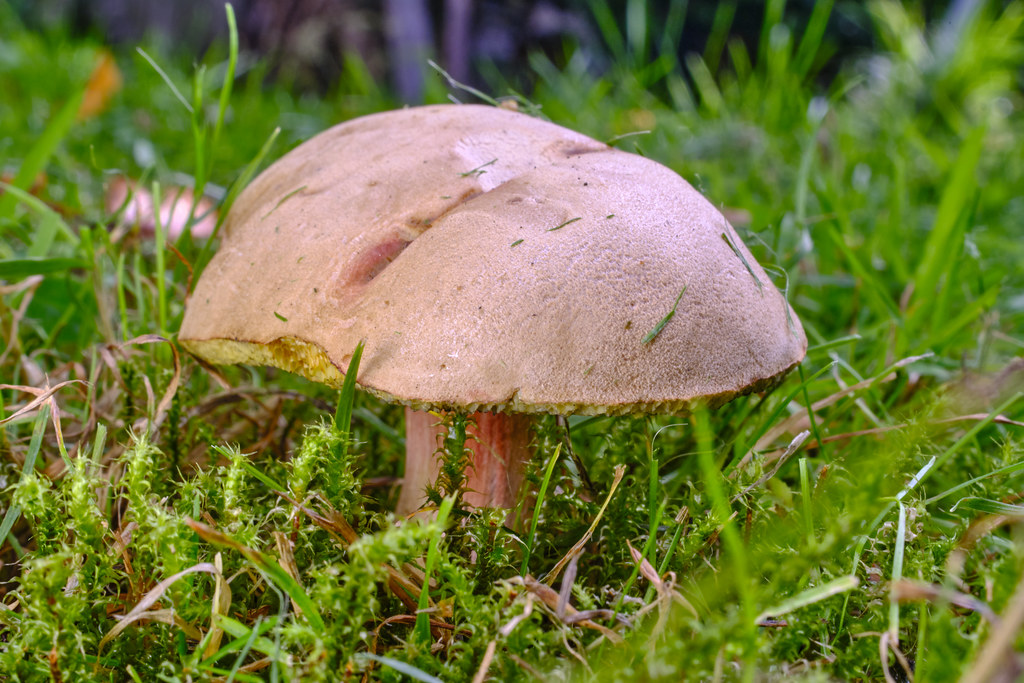
- Measures 2–8 cm wide; starts hemispherical then becomes convex; surface is finely velvety when young, maturing to a smooth and somewhat shiny texture that cracks to reveal pinkish or yellowish flesh beneath.
- Stem
- Measures 2–6 cm tall and is of uniform thickness; base color is pale yellowish with dark yellow to brown stripes, darkening with age; the top is bright yellow, often showing pink flushes or stripes in younger specimens.
- Pores
- Large and irregularly shaped; initially bright yellow, maturing to a dark greenish-yellow or orange-brown; bruises dark greenish-blue when touched.
- Tubes
- Adnate attachment to the stem; coloration follows the same patterns as the pores.
- Flesh
- Fairly firm; white to pale yellow in the cap, turning pinkish or bluish when cut; does not contain orange spots; may turn blue at the stem apex.
- Spore print
- Olive-green to brown.
Sporecast is better in the app
Plan ahead with 10-day forecasts, see what people are finding nearby, get photo IDs, and track your finds.
Edibility
This species can easily be confused with Xerocomus communis, but it lacks that mushroom's orange spots in the flesh. The flesh is fairly firm and turns from white or pale yellow to pinkish or blue, while the bright yellow pores and tubes bruise a dark green-blue.
Misidentification can be fatal. Never eat a mushroom unless you're 100% sure. This information may be inaccurate. Always consult multiple sources.
Nutrient Source
EctomycorrhizalIt forms an ectomycorrhizal (EcM) association with specific tree species, meaning it lives in symbiosis with the tree's roots, exchanging nutrients.
Common Names
- Dutch
- Bruingele fluweelboleet
- English
- Ascot Hat
- German
- Blassgelber Filzröhrling
- Welsh
- Cap Tyllog Bwff
Synonyms
- Boletus bubalinus — Ascot Hat
- Xerocomellus bubalinus
- Xerocomus bubalinus