
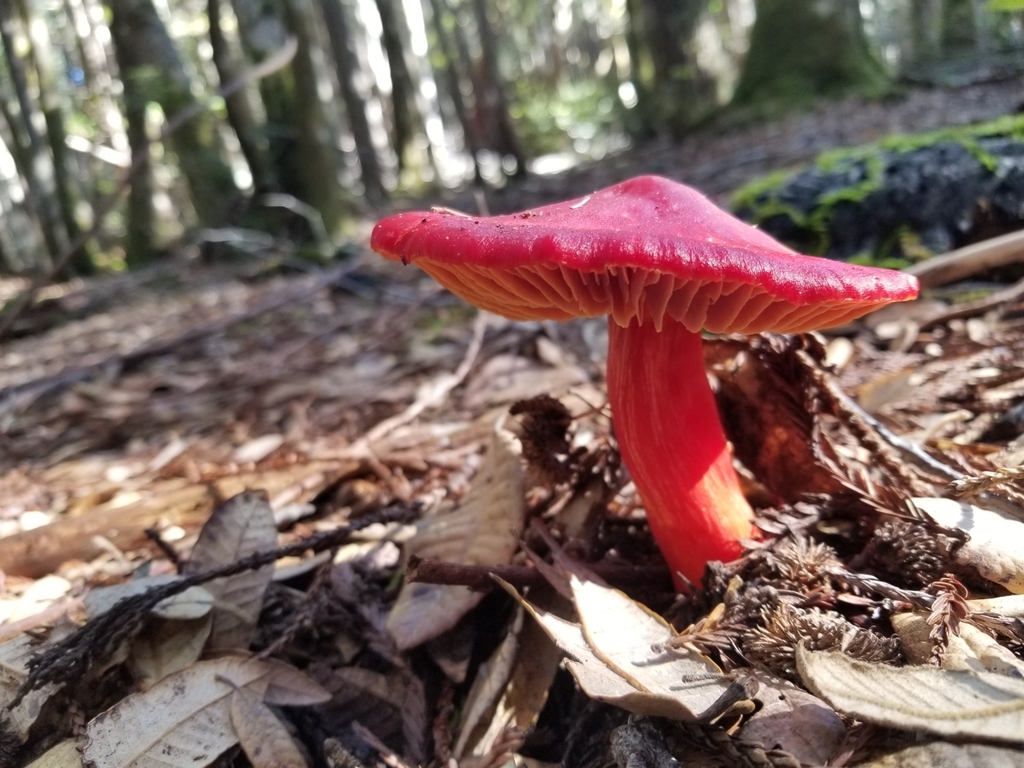
Habitat
This species is found on the ground among short grass on heaths, unimproved grassland, and turf. It also occurs in moss, well-decayed duff under redwoods, and within conifer or mixedwood forests. It typically grows solitarily, in small groups, or trooping.
Photos
Appearance
- Cap
- 2–15 cm wide, starting bell-shaped or convex, later flattening with a broad umbo and irregular, wavy, or lobed margins. The surface is deep blood-red to crimson, fading to orange-red or buff with age, and has a greasy to slightly slimy texture.
- Stem
- 5–20 cm long and 0.5–3 cm thick, stout and often hollow. The surface is dry, yellow to reddish, and marked with coarse longitudinal fibers. The base is notably white and often tapers or points downward.
- Gills
- Widely spaced and thick with a waxy feel. Color transitions from pale yellow or yellowish-orange to deep orange or reddish-brown. The attachment is typically adnexed, notched, or slightly decurrent.
- Flesh
- Fairly thick but fragile, white in the center of the stem and base, while yellowish to reddish under the cap surface.
- Spore print
- White.
Sporecast is better in the app
Plan ahead with 10-day forecasts, see what people are finding nearby, get photo IDs, and track your finds.
Edibility
While described as a worthwhile edible that is more substantial than most waxcaps, it is not universally recommended because some individuals have reported minor gastrointestinal distress and adverse effects. It is very similar to the equally edible splendid waxcap (Hygrocybe splendidissima) but can be distinguished from the scarlet waxcap (Hygrocybe coccinea) by its larger size, fibrous-lined stem, and a stem base that is typically white rather than deep red. The mushroom has a mild or indistinct taste and smell.
Misidentification can be fatal. Never eat a mushroom unless you're 100% sure. This information may be inaccurate. Always consult multiple sources.
Nutrient Source
otherIt is not a saprotroph, but may be biotrophic, potentially forming mycorrhizal relationships with plants or living as an endophyte. It may also obtain nutrients from soil invertebrates.
Common Names
- Basque
- ezko gorri
- Croatian
- Velika Vlažnica
- Danish
- Skarlagen-vokshat
- Dutch
- Granaatbloemwasplaat
- English
- Crimson Wax Cap, Crimson Wax-Cap, Crimson Waxcap
- Estonian
- Hiid-vesinutt
- Finnish
- punikkivahakas
- French
- Hygrocybe ponceau
- German
- Granatroter Saftling, Größter Saftling, Rotkegeliger Saftling
- Macedonian
- Огнена влажница
- Norwegian
- Skarlagenvokssopp
- Norwegian Bokmål
- skarlagenvokssopp
- Norwegian Nynorsk
- skarlaksvokssopp
- Scottish Gaelic
- cupa-cèireach dearg, cupannan-cèireach dearg
- Slovak
- Lúčnica Granátovočervená
- Spanish
- ezko gorri handi, higróforo rojo, Higroforo rojo
- Swedish
- scharlakansvaxing, Scharlakansvaxskivling
- Welsh
- Cap Cŵyr Rhuddgoch
Synonyms
- Agaricus puniceus
- Godfrinia acutopunicea
- Godfrinia punicea
- Hydrophorus puniceus
- Hygrocybe acutopunicea
- Hygrophorus acutopuniceus
- Hygrophorus puniceus
- Pseudohygrocybe punicea