
Habitat
This common species is found on the ground in a variety of environments, including woodlands, grasslands, fields, and gardens. It frequently inhabits disturbed areas, waste ground, and compacted soil along roadsides, woodland paths, and trails. It may be found growing solitarily or in small, tufted groups and clusters on nutrient-rich soil, mulched beds, wood chips, and areas containing woody debris.
Photos
Appearance
- Cap
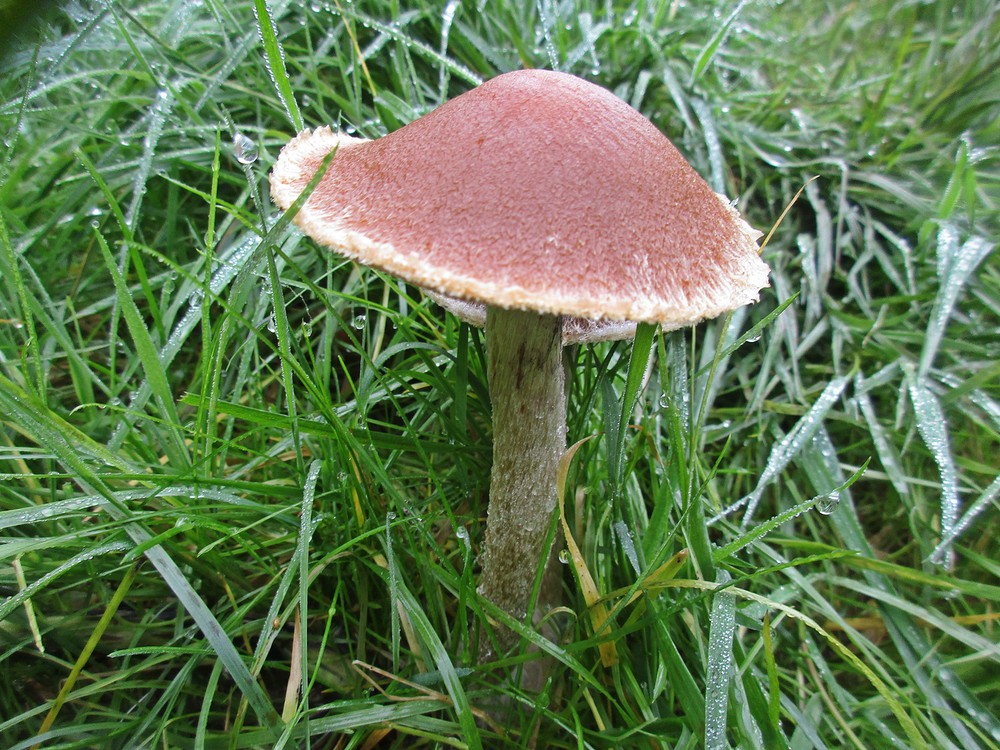
- 1.5–10 cm wide, initially convex, hemispheric, or bell-shaped with a broad umbo, flattening with age. The surface is dry, ochre-brown to tan or orangey-brown, and covered in woolly, fibrous hairs that may become smoother in maturity. The margin is often fringed with hanging, cottony veil remnants.
- Stem
- 3–10 cm long and 0.3–2 cm thick, cylindrical or slightly tapering upwards. It is whitish at the apex and darker/ochre-brown toward the base. The surface is fibrous to scaly below a distinctive, cobwebby ring zone that often becomes blackened by trapped spores.
- Gills
- Crowded and adnate to nearly free. They are mottled dark purplish-brown to black with distinct white edges. When moist or young, they characteristically 'weep' clear or milky droplets.
- Flesh
- Thin, fragile, and pale yellow-brown to buff. The stem becomes hollow as it matures.
- Spore print
- Black to dark purplish-brown.
- Odor
- Indistinct, earthy, or musty.
- Taste
- Mild to slightly bitter.
Sporecast is better in the app
Plan ahead with 10-day forecasts, see what people are finding nearby, get photo IDs, and track your finds.
Edibility
This mushroom is edible but often has a faint, slightly bitter flavor that may be mitigated by frying with salt. It can be confused with Inocybe or Cortinarius species, though these lookalikes have rusty brown rather than blackish spore prints. While members of the Psathyrellaceae family may look similar, none are considered seriously toxic, but foragers should still exercise caution as the species can resemble other toxic groups.
Misidentification can be fatal. Never eat a mushroom unless you're 100% sure. This information may be inaccurate. Always consult multiple sources.
Nutrient Source
SaprotrophicIt obtains nutrients by decomposing dead organic matter, such as dead wood and grass.
Common Names
- Basque
- drosofila malkodun
- Danish
- Grædende mørkhat
- Dutch
- Tranende franjehoed
- English
- Weeping Widow
- French
- Lacrymaire veloutée, Lacrymaire velouté
- German
- Tränender Saumpilz
- Norwegian Bokmål
- lodnehatt
- Norwegian Nynorsk
- lodnehatt
- Spanish
- Psatirela aterciopelada, lacrimaria aterciopelada
- Swedish
- tårsprödskivling, tårspröding
- Welsh
- Dagrau'r Weddw
Synonyms
- Agaricus areolatus
- Agaricus lacrymabundus
- Agaricus macrourus
- Agaricus velutinus
- Coprinus velutinus
- Cortiniopsis lacrymabundus
- Drosophila lacrymabunda
- Drosophila velutina
- Geophila lacrymabunda
- Glyptospora velutina
- Hypholoma aggregatum
- Hypholoma boughtonii
- Hypholoma lacrymabundum
- Hypholoma lacrymabundum
- Hypholoma lacrymabundum
- Hypholoma velutinum
- Hypholoma velutinum
- Hypholoma velutinum
- Lacrymaria velutina
- Lacrymaria velutina
- Psathyra lacrymabunda
- Psathyrella lacrymabunda
- Psathyrella lacrymabunda
- Psathyrella velutina
- Psilocybe areolata