
Habitat
This species is found growing on soil, leaf litter, and duff in a variety of environments, most commonly in broad-leaved, coniferous, and mixedwood forests. It typically inhabits decaying debris under hardwoods and conifers, including redwood and Sitka spruce, but can also be found in moss, on well-decayed wood, and in non-forested habitats such as grasslands, sand dunes, and shingle beaches.
Photos
Appearance
- Cap
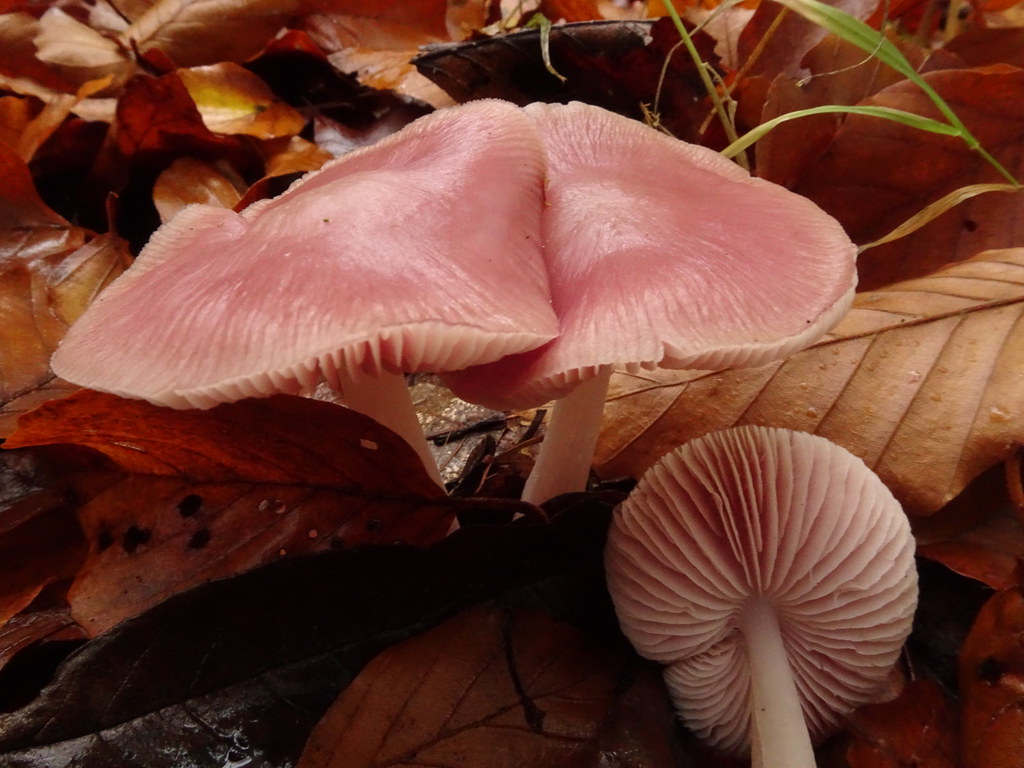
- 1–5 cm across; initially bell-shaped, becoming convex to flat, often with a broad central bump. The surface is smooth, moist to slightly greasy, and strongly hygrophanous, appearing shiny and translucent-lined when wet but dull and opaque when dry. Color is highly variable, ranging from lilac, purple, and pink to yellow or white, often fading to grey or whitish with age.
- Gills
- Broadly attached to the stem, sometimes with a small decurrent tooth; close to somewhat distant. They are often lilac, pale pink, or purplish when young, aging to white or greyish. Cross-veining between the gills is common in mature specimens.
- Stem
- 3–10 cm long and up to 8 mm thick; rigid yet fragile, cartilaginous, and hollow. The color typically matches the cap but is often paler. The surface is smooth toward the top and covered in fine whitish or yellowish hairs at the base.
- Flesh
- Thin and fragile; colored lilac-grey, bluish, or white. It has a distinct odor and taste reminiscent of radishes or cucumbers.
- Spore print
- White.
Sporecast is better in the app
Plan ahead with 10-day forecasts, see what people are finding nearby, get photo IDs, and track your finds.
Edibility
The species is of uncertain edibility and may be poisonous, with chemical studies indicating it contains small amounts of the toxin muscarine. Both the flavor and odor are described as being like radishes or cucumbers. It can be confused with Mycena pelianthina, which has dark purple-edged gills, or Laccaria species which have more widely spaced gills and fibrous stems. Other lookalikes include purple-capped Inocybe species, which are distinguished by their brown spores, silky caps, and cobwebby veils.
Misidentification can be fatal. Never eat a mushroom unless you're 100% sure. This information may be inaccurate. Always consult multiple sources.
Nutrient Source
facultativeThis fungus primarily decomposes dead organic matter, such as leaf litter and wood debris. However, it can also invade living plant roots, sometimes forming symbiotic relationships where it may exchange nutrients with the plant, or acting as a parasite.
Common Names
- Danish
- Skær huesvamp
- Dutch
- Gewoon elfenschermpje
- English
- Lilac Bonnet
- Finnish
- sinipunahiippo
- French
- Mycène pur
- German
- Rettich-Helmling
- Norwegian Bokmål
- reddikhette
- Norwegian Nynorsk
- reddikhette
- Swedish
- rättikhätta
- Welsh
- Bonet Lelog
Synonyms
- Agaricus ianthinus
- Agaricus pseudopurus
- Agaricus purpureus
- Agaricus purus
- Gymnopus purus
- Mycena carnea
- Mycena ianthina
- Mycena ianthina
- Mycena ianthina
- Mycena pseudopura
- Mycena pura
- Mycenula pura
- Poromycena pseudopura
- Prunulus purus