
Habitat
Frequently found on the wood of deciduous trees, specifically growing on stumps, logs, and large fallen branches. It shows a preference for hardwoods such as beech, birch, and ash, and is particularly common in areas where oaks and tanoaks are abundant. Fruitbodies may occur solitarily, in scattered groups, or in dense, sometimes fused clusters.
Photos
Appearance
- Cap
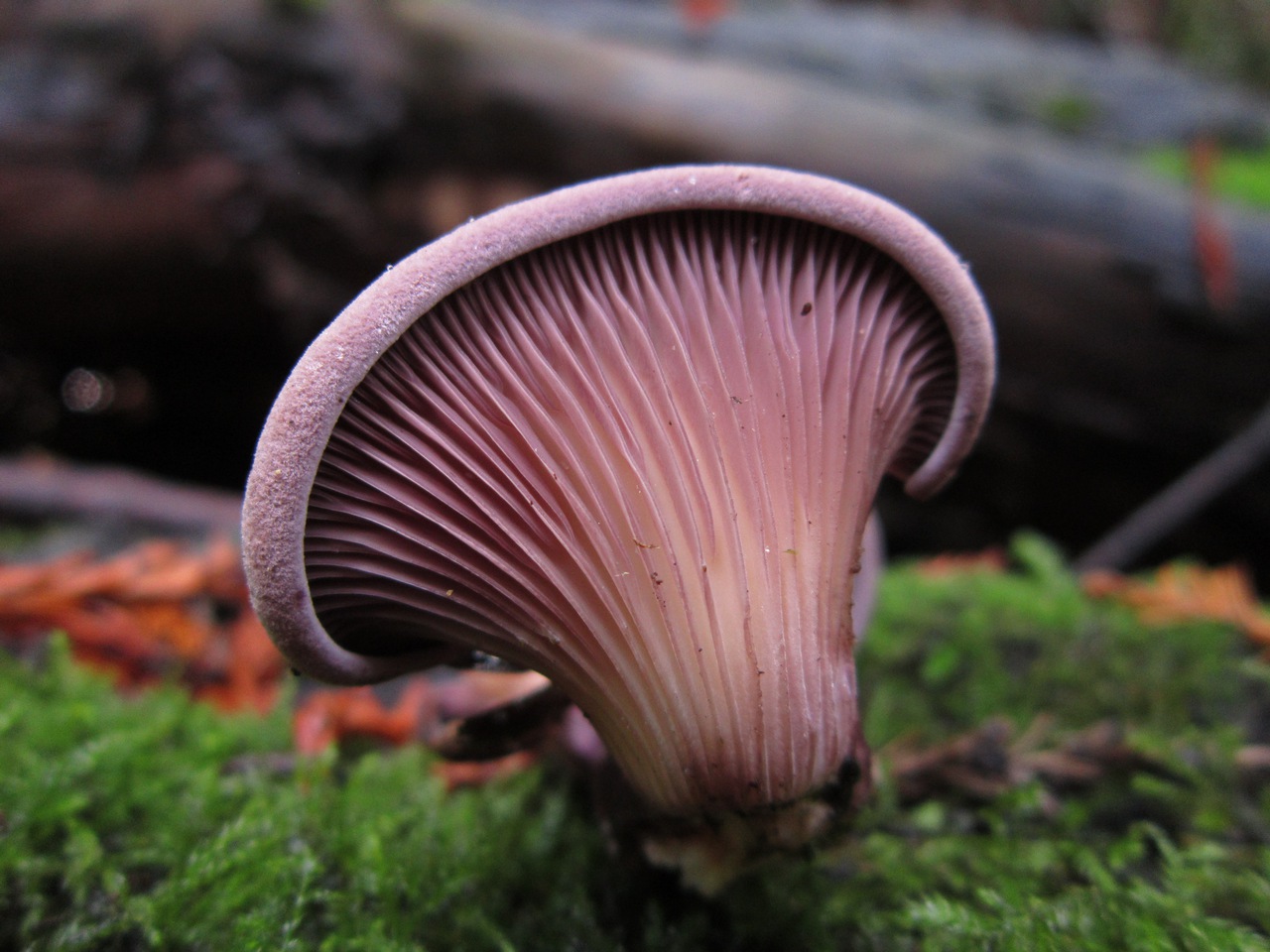
- 3–15 cm wide; initially button-like or shell-shaped, maturing to become funnel-shaped or concave with a wavy, inrolled margin. Colors shift from vivid royal purple or lilac when young to reddish-brown, tan, or beige with age. Surface is dry and velvety or finely scaly, sometimes appearing cracked over time.
- Stem
- 1–8 cm long and 1–4 cm thick; typically off-center or lateral and often stocky. Matches the cap color with a lilac bloom or fuzz when young, becoming smoother and grayish-beige with age. The base often tapers and may be embedded in the wood.
- Gills
- Deeply decurrent and sometimes forked or wrinkled near the stem. Initially lilac, lavender, or flesh-colored, fading to a creamy ochre or yellowish-tan as the mushroom matures.
- Flesh
- Whitish; the texture is notably tough, firm, and leathery or rubbery.
- Spore print
- White to pale cream.
Sporecast is better in the app
Plan ahead with 10-day forecasts, see what people are finding nearby, get photo IDs, and track your finds.
Edibility
The flesh of this species is notably tough, rubbery, or leathery, making it inedible. While the taste is often indistinct, it can sometimes be faintly bitter, and the odor has been described as strongly unpleasant with sweet, fruity, or cheesy notes.
Misidentification can be fatal. Never eat a mushroom unless you're 100% sure. This information may be inaccurate. Always consult multiple sources.
Nutrient Source
SaprotrophicIt obtains nutrients by decomposing dead wood from hardwood trees.
Common Names
- Basque
- montzondo-belarri leuna, motzondo-belarri leun
- Catalan
- pano concoide
- Danish
- Filtstokket læderhat
- Dutch
- Trechtertaaiplaat
- English
- Lilac Oysterling
- Finnish
- rustovinokas
- German
- Birken-Knäueling
- Norwegian Bokmål
- stor lærhatt
- Norwegian Nynorsk
- stor lêrhatt
- Swedish
- broskmussling
- Welsh
- Cragen Lelog
Synonyms
- Agaricus carneotomentosus
- Agaricus carneotomentosus
- Agaricus carnosus
- Agaricus conchatus
- Agaricus flabellatus
- Agaricus flabelliformis
- Agaricus fornicatus
- Agaricus inconstans
- Agaricus inconstans
- Agaricus mesentericus
- Agaricus torulosus
- Clitocybe inconstans
- Lentinellus torulosus
- Lentinopanus conchatus
- Lentinus bresadolae
- Lentinus carneotomentosus
- Lentinus conchatus
- Lentinus conchatus
- Lentinus divisus
- Lentinus inconstans
- Lentinus obconicus
- Lentinus percomis
- Lentinus torulosus
- Lentinus vaporarius
- Panus carneotomentosus
- Panus carneotomentosus
- Panus flabelliformis
- Panus monticola
- Panus torulosus
- Panus vaporarius
- Pleuropus fornicatus
- Pleuropus inconstans
- Pleuropus torulosus
- Pleurotus carneotomentosus
- Pleurotus conchatus
- Pleurotus conchatus
- Pleurotus torulosus
- Pocillaria conchata
- Pocillaria divisa
- Pocillaria krombholzii
- Pocillaria percomis
- Pocillaria torulosa
- Pocillaria vaporaria