
Habitat
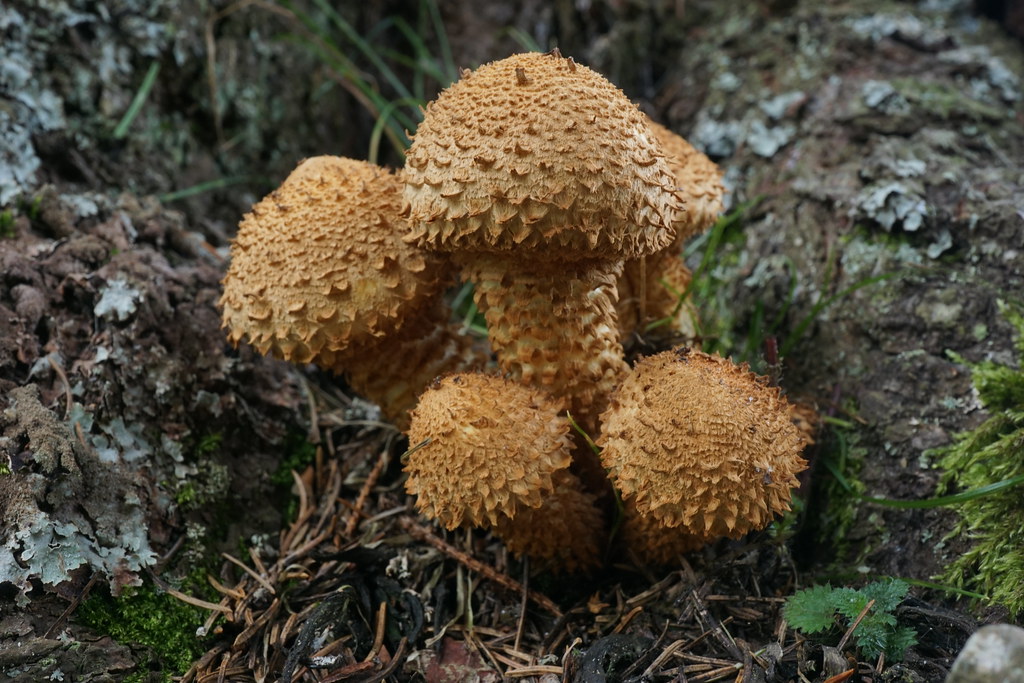
This species grows in dense, tufted clusters on the wood of both living and dead trees. It is primarily found at the base of trunks or on stumps of deciduous trees, such as beech, rowan, and apple, though it occurs occasionally on conifers. It is considered a partial parasite.
Photos
Appearance
- Cap
- 3–11 cm wide, ranging from bell-shaped or convex to nearly flat, often with an inrolled margin. The dry surface is pale straw-yellow, tan, or pale orange-cream and is densely covered with coarse, dark red-brown, upturned scales often arranged in concentric rings.
- Stem
- 5–15 cm long and up to 1.5 cm wide, often tapering toward the base and curved. It is smooth and pale yellow above a ragged, membranous ring; below the ring, it is covered in coarse, recurved scales matching the cap color.
- Gills
- Crowded and attached to the stem, sometimes slightly running down it. Initially pale yellow or greenish-yellow, they eventually turn cinnamon or rusty brown as the spores mature.
- Flesh
- Tough and pale yellow, often darkening to a deep red-brown or orange near the base of the stem.
- Spore print
- Rusty brown.
- Odour and Taste
- Distinctive radish-like or garlic-like smell; the taste is described as radish-like, rancid, or unpleasant.
Sporecast is better in the app
Plan ahead with 10-day forecasts, see what people are finding nearby, get photo IDs, and track your finds.
Edibility
Eating this mushroom can lead to severe gastrointestinal upset. It is known to cause toxic reactions when consumed alongside alcohol, though some individuals may experience poisoning even without alcohol. It has a tough flesh and a taste or odor variously described as radish-like, garlicky, or rancid. It can be confused with edible Honey Mushrooms, which are distinguished by their white spore print, and Pholiota squarrosoides, which has a slimy cap surface.
Misidentification can be fatal. Never eat a mushroom unless you're 100% sure. This information may be inaccurate. Always consult multiple sources.
Nutrient Source
facultativeIt obtains nutrients by decomposing dead organic matter and can also act as a parasite, feeding on living trees.
Common Names
- Basque
- egur-ziza ezkatatsua, egur-ziza ezkatatsu
- Danish
- Krumskællet skælhat
- Dutch
- Schubbige bundelzwam
- English
- Shaggy Scalycap, Shaggy Pholiota
- Finnish
- pörhösuomuhelokka
- French
- Pholiote écailleuse
- German
- Sparriger Schüppling
- Norwegian Bokmål
- raspskjellsopp
- Norwegian Nynorsk
- raspskjelsopp
- Spanish
- foliota escuarrosa, foliota escamosa
- Swedish
- fjällig tofsskivling
- Welsh
- Cap Cennog Blewog
Synonyms
- Agaricus floccosus
- Agaricus reflexus
- Agaricus scandinaviae
- Agaricus squarrosus
- Agaricus squarrosus
- Agaricus squarrosus
- Agaricus squarrosus
- Agaricus verruculosus
- Dryophila muelleri
- Dryophila squarrosa
- Dryophila verruculosa
- Fungus squarrosus
- Gymnopus reflexus
- Hypodendrum floccosum
- Lepiota squarrosa
- Pholiota muelleri
- Pholiota reflexa
- Pholiota verruculosa
- Stropharia squarrosa