
Habitat
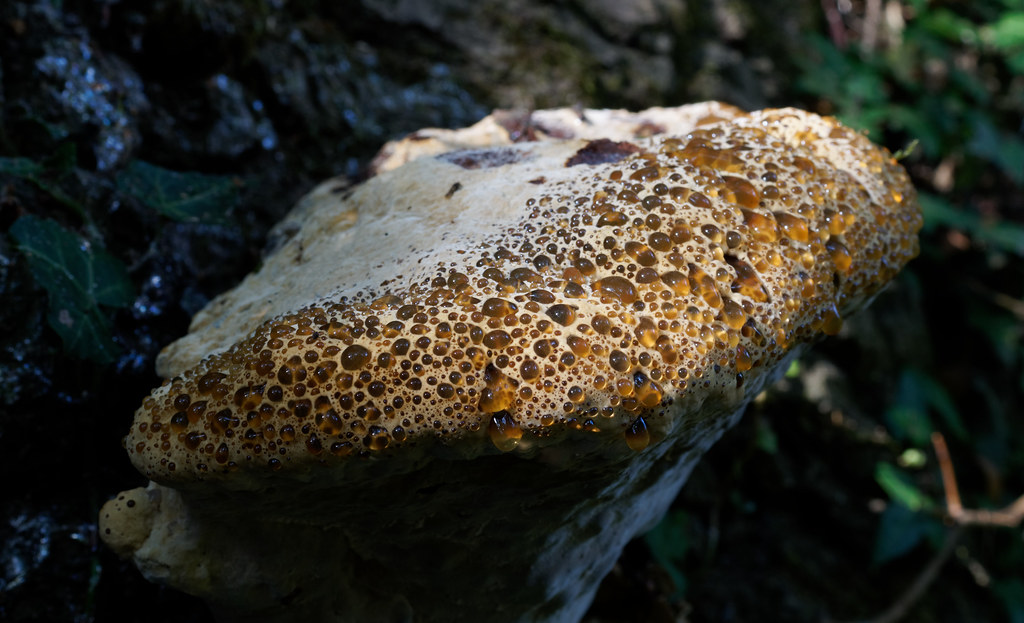
This parasitic fungus grows at the base of living broad-leaved trees, where it causes white rot. While it is occasional on other hardwoods, it is found almost exclusively on various species of oak. It typically grows as a solitary bracket or in fused, overlapping clusters.
Photos
Appearance
- Bracket
- Thick, corky, and irregularly shaped, ranging from 5 to 65 centimeters across; initially whitish-grey or yellowish before turning rusty brown to dark brown. The uneven upper surface is often warty and exudes amber or reddish liquid drops from the margin during active growth.
- Pores
- Small, circular to angular openings, measuring 3 to 5 per millimeter; color transitions from whitish-grey or yellow-brown to a deep rusty brown.
- Tubes
- Measured between 5 and 20 millimeters deep, colored dull rusty brown.
- Flesh
- Soft and fibrous texture, ranging in color from yellowish to a deep reddish or rusty brown.
- Stem
- Absent; the fruit body is attached directly and broadly to the host tree.
- Spore print
- White to yellowish.
- Smell
- Strong and unpleasant.
Sporecast is better in the app
Plan ahead with 10-day forecasts, see what people are finding nearby, get photo IDs, and track your finds.
Edibility
This species has a mild but acidic taste and a strong, unpleasant smell. The flesh is described as fibrous, corky, or soft and is not considered edible.
Misidentification can be fatal. Never eat a mushroom unless you're 100% sure. This information may be inaccurate. Always consult multiple sources.
Nutrient Source
ParasiticIt feeds on the heartwood of living trees, primarily oaks, and can also grow on deadwood, causing rot in the base of the trunk.
Common Names
- Danish
- Ege-spejlporesvamp
- Dutch
- eikeweerschijnzwam, Eikenweerschijnzwam, Eikeweerschijnzwam
- English
- Oak Bracket
- French
- Inpneute du chêne, Polypore larmoyant
- German
- Tropfender Schillerporling
- Norwegian Bokmål
- tårekjuke
- Norwegian Nynorsk
- tårekjuke
- Swedish
- tårticka
- Welsh
- Ysgwydd Derw
Synonyms
- Boletus dryadeus
- Boletus pseudoigniarius
- Fomes dryadeus
- Fomitiporia dryadea
- Inonotus dryadeus
- Ischnoderma dryadeum
- Phellinus dryadeus
- Placodes dryadeus
- Polyporus dryadeus
- Ungularia dryadea
- Xanthochrous dryadeus