
Habitat
This species occurs in broad-leaved woodlands, parklands, and roadside verges, primarily associating with oak or beech trees. It prefers alkaline or calcareous soils. Additionally, it can be found in alkaline grasslands among montane species such as common rock-rose. It grows either solitary or in small clusters.
Photos
Appearance
- Cap
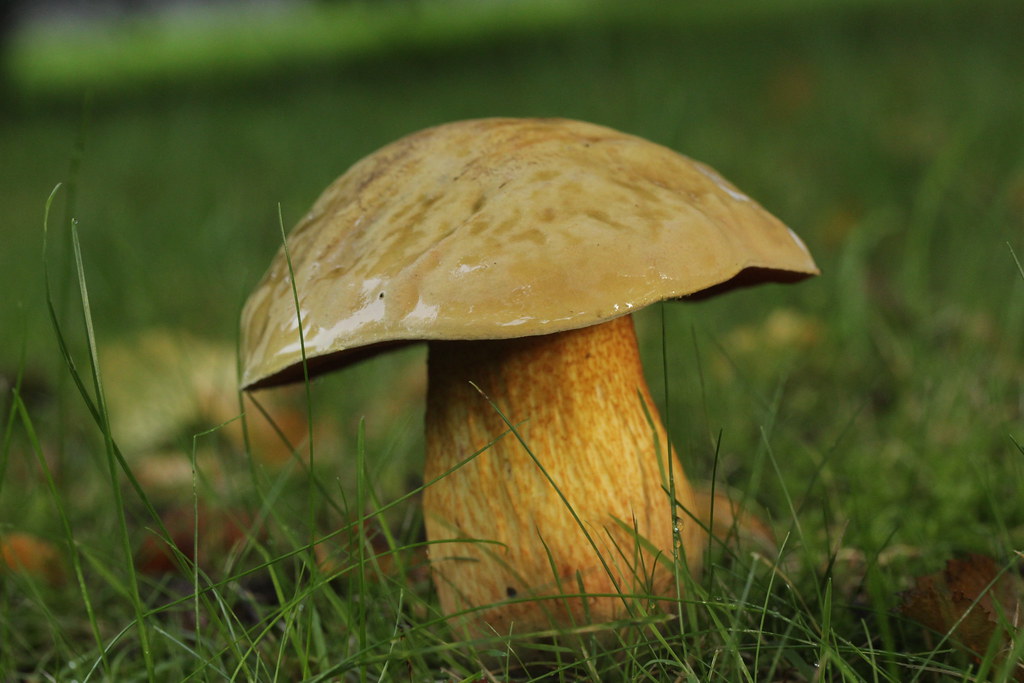
- Measures 3 to 18 cm across, starting hemispherical before flattening; the color ranges from walnut or olive-brown with reddish or bay tints, bruising blue-black or brownish; texture is initially finely downy, later becoming smooth and polished.
- Stem
- Stout, 8 to 14 cm tall, often tapering toward the top; typically yellow-orange at the apex, reddish in the middle, and purple-brown or blackish-red at the base; covered in a distinct orange-red netted pattern that bruises blue.
- Pores
- Small and round, initially greenish-yellow but maturing to orange-red; they turn blue immediately when touched or handled.
- Tubes
- Yellowish-green in color and free from the stem, quickly turning blue when cut.
- Flesh
- Firm and lemon-yellow, though reddish in the stem and at the stem base; when sliced, it quickly turns dark blue or greenish-blue, notably showing a persistent red line situated between the cap flesh and the tubes.
- Spore print
- Olive-brown to olive-green.
Sporecast is better in the app
Plan ahead with 10-day forecasts, see what people are finding nearby, get photo IDs, and track your finds.
Edibility
This species must be cooked before consumption to be safe, though some individuals may still experience gastric upset after eating it. Its firm flesh has a mild, pleasant taste and smell, but it is known to rapidly turn greenish-blue or dark blue when sliced or handled.
Misidentification can be fatal. Never eat a mushroom unless you're 100% sure. This information may be inaccurate. Always consult multiple sources.
Nutrient Source
EctomycorrhizalIt lives in a symbiotic relationship with trees, exchanging nutrients with their roots.
Common Names
- Basque
- bey-onyoa, onddo zikin, mataparent, bey-onto, errementiono
- Catalan
- mataparent, mataparents, mataparent lívid
- Danish
- Netstokket indigorørhat
- Dutch
- Netstelige heksenboleet
- English
- Lurid Bolete
- Finnish
- tauriontatti
- French
- Bolet blafard
- German
- Netzstieliger Hexenröhrling
- Norwegian Bokmål
- ildrørsopp
- Norwegian Nynorsk
- eldrøyrsopp
- Spanish
- galambo bueno, bey-onyua, hongo de vaca, panda azul, boleto cetrino
- Swedish
- eldsopp
- Welsh
- Cap Tyllog Llwydfelyn
Synonyms
- Boletus erythrentheron
- Boletus luridus
- Boletus luridus
- Boletus perniciosus
- Boletus rubeolarius
- Boletus sordarius
- Boletus subvescus
- Boletus tuberosus
- Boletus xanthorhodius
- Dictyopus luridus
- Dictyopus meyeri
- Dictyopus tuberosus
- Leccinum luridum
- Leccinum rubeolarium
- Polyporus meyeri
- Suillus luridus
- Suillus rubeolarius
- Tubiporus luridus