
Habitat
This species grows on soil in both broad-leaved and coniferous woodlands. It is commonly found associated with beech, live oak, pine, spruce, and fir. It may fruit solitarily, in small groups, or in tufted clusters.
Photos
Appearance
- Cap
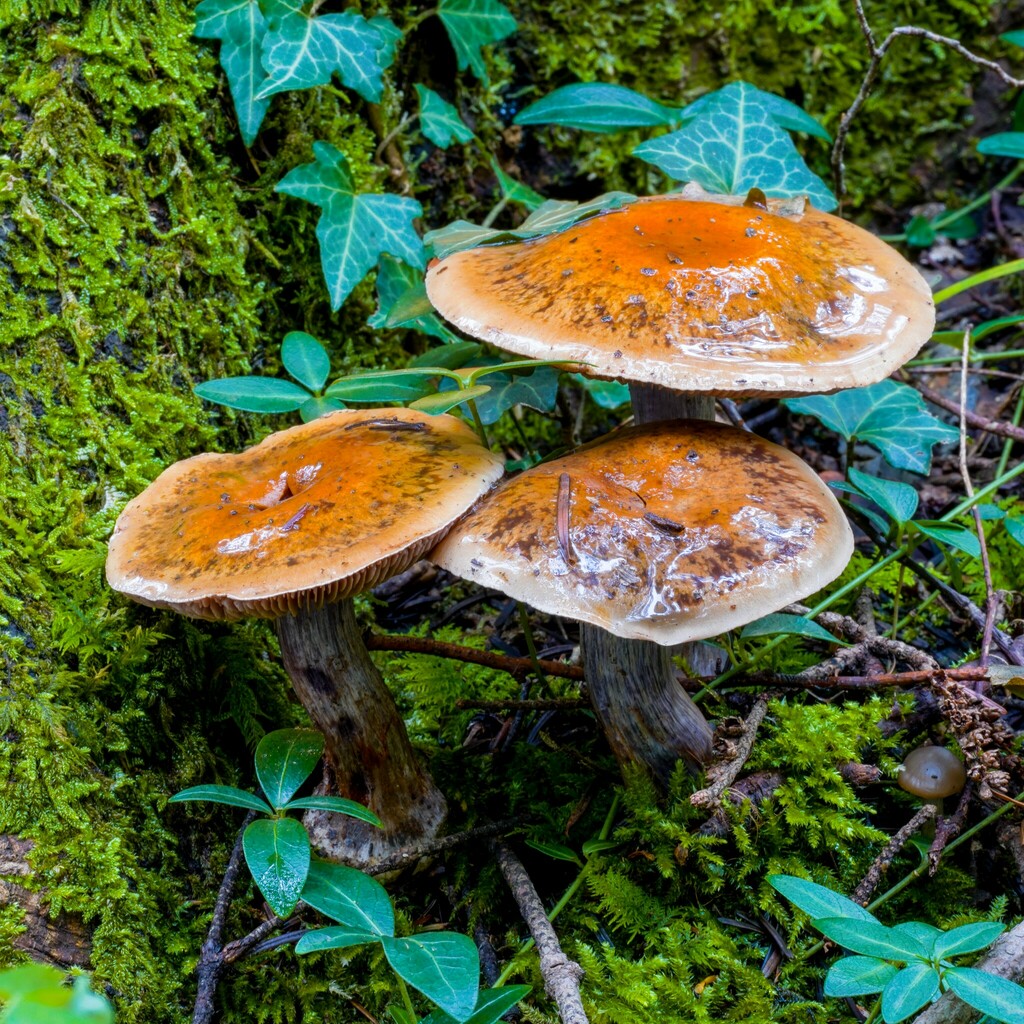
- 4–15 cm wide, evolving from hemispherical to convex, then flattened or slightly depressed; surface is sticky or slimy when wet, featuring dark streaks or spots; color ranges from violet-brown to dingy tan, orange-brown, or reddish-brown.
- Stem
- 5–12 cm tall, stout and cylindrical with a bulbous or club-shaped base; color is violet, lilac, or whitish, often with a silvery sheen; surface is dry and bruises purple when handled.
- Gills
- Crowded and adnate to notched; initially purple-violet or lilac, mature to reddish-brown; notably bruising deep amethyst or purple when damaged.
- Flesh
- Thick and firm; colored whitish, pale violet, or lilac-gray; quickly bruising deep violet or purple when cut.
- Partial veil
- A prominent, cobweb-like cortina consisting of whitish to purplish fibers.
- Spore print
- Red-brown to rusty brown.
Sporecast is better in the app
Plan ahead with 10-day forecasts, see what people are finding nearby, get photo IDs, and track your finds.
Edibility
The flesh and gills of this mushroom bruise a distinctive amethyst or deep violet color when scraped or damaged. While reported as edible by some, it has an unpleasant or faint taste and can be easily confused with wood blewits or various other webcap species. Due to its poor flavor and the risk of misidentification with potentially dangerous lookalikes, it is often recommended to be avoided.
Misidentification can be fatal. Never eat a mushroom unless you're 100% sure. This information may be inaccurate. Always consult multiple sources.
Nutrient Source
EctomycorrhizalIt forms a symbiotic relationship with trees, exchanging nutrients and minerals from the soil for sugars produced by the tree.
Common Names
- Basque
- sare purpurakorra, sare purpurakor
- Catalan
- cortinari purpuri
- Dutch
- Purperen gordijnzwam
- English
- Bruising Webcap
- French
- Cortinaire pourpre
- German
- Purpurfleckender Klumpfuss
- Norwegian Bokmål
- purpurslørsopp
- Norwegian Nynorsk
- purpurslørsopp
- Spanish
- cortinario púrpura, cortinaria purpúrea, Cortinario purpúreo
- Swedish
- blånande lök-spindelskivling, blånande lökspindelskivling, blånande lökspindling, purpurspindling
- Ukrainian
- Павутинник червонуватий
- Welsh
- Cap Gweog Cleisiol
Synonyms
- Agaricus purpurascens
- Cortinarius purpurascens — Bruising Webcap
- Gomphos purpurascens
- Phlegmacium purpurascens