
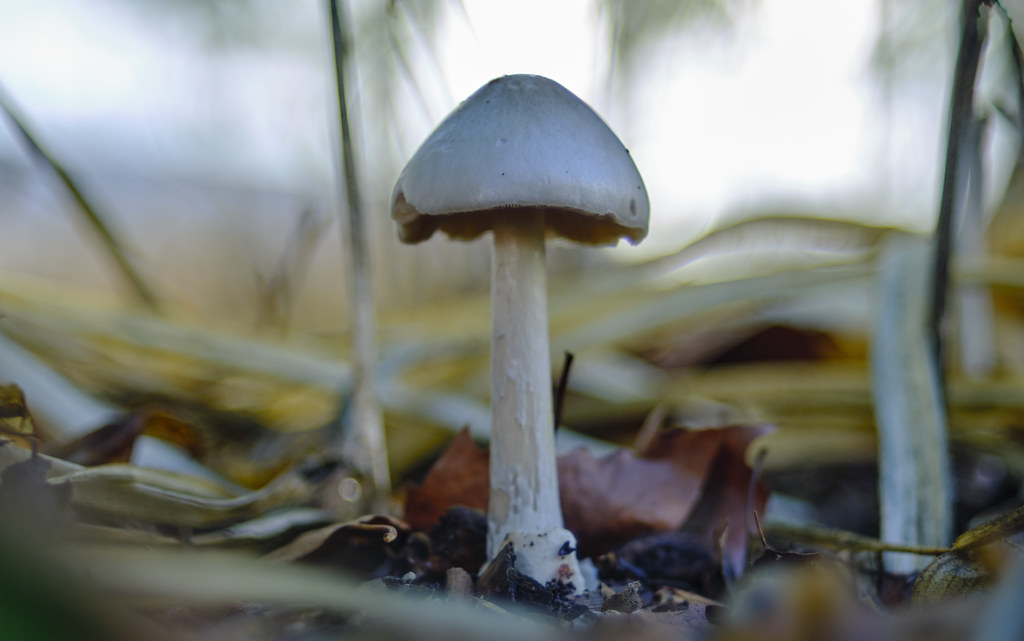
Habitat
This saprophytic species thrives on nutrient-rich or disturbed ground including agricultural land, bare stubble fields, gardens, and road verges. It is frequently found on organic debris such as compost heaps, manure, rotting straw, wood chips, and lignin-rich mulch. It may grow solitarily, in clusters, or in large troops, often appearing in urban landscaped areas or on grass.
Photos
Appearance
- Cap
- 5–15 cm wide; initially egg-shaped, becoming convex to flat, often with a low central bump; colors range from white to gray-brown, often darkest at the center and sometimes radially streaked with dark fibrils; surface is notably viscid or sticky when moist, becoming shiny when dry.
- Gills
- Crowded and free from the stem; initially white or creamy, turning a distinct salmon-pink to tan-pink as the spores mature.
- Stem
- 5–20 cm long, 1–4 cm thick; white to creamy, becoming dingy tan with age; lacks a ring; tapers upward from a club-shaped base.
- Volva
- A large, bag-like, membranous structure enclosing the base of the stem; white to grayish, it can be fragile and may become less distinct as the mushroom ages.
- Flesh
- White or marbled with gray; moderately thick and firm when young, becoming soft with age.
- Spore print
- Salmon-pink to pinkish tan.
- Odor
- Variable, described as earthy, radish-like, or resembling bean sprouts.
- Taste
- Mild, sometimes reported as radish-like.
Sporecast is better in the app
Plan ahead with 10-day forecasts, see what people are finding nearby, get photo IDs, and track your finds.
Edibility
Extreme caution is required to avoid confusing this mushroom with the deadly Amanita phalloides (Death Cap). Key differences include the pink spore print and lacks of a stem ring in this species, whereas toxic Amanitas have white spores and usually possess a ring. This mushroom is often described as having soft flesh and a flavor or aroma reminiscent of radish, bean sprouts, or mild earthy mustiness. It is reported to be better when collected young, and foragers should be aware that it may grow in areas treated with pesticides or pollutants.
Misidentification can be fatal. Never eat a mushroom unless you're 100% sure. This information may be inaccurate. Always consult multiple sources.
Nutrient Source
SaprotrophicIt obtains nutrients by decomposing dead organic matter in soil, such as decaying plant material.
Common Names
- Basque
- kosko-ziza lingirdatsu, kosko-ziza lingirdatsua
- Danish
- Høj posesvamp
- Dutch
- Gewone beurszwam
- English
- Stubble Rosegill
- Finnish
- tarhatuppisieni
- French
- Volvaire gluante
- German
- Großer Scheidling
- Norwegian Bokmål
- kompostsliresopp
- Norwegian Nynorsk
- kompostsliresopp
- Spanish
- gurumelo, volvaria vistosa
- Swedish
- vanlig slidskivling, vit slidskivling
- Welsh
- Tagell Rosliw Ben Gludiog
Synonyms
- Agaricus gloiocephalus
- Agaricus gloiocephalus
- Agaricus pubescens
- Agaricus speciosus
- Amanita speciosa
- Pluteus speciosus
- Volvaria gloiocephala
- Volvaria pubescens
- Volvaria speciosa
- Volvaria speciosa
- Volvariella gloiocephala — Stubble Rosegill
- Volvariella gloiocephala
- Volvariella speciosa
- Volvariopsis gloiocephala
- Volvariopsis speciosa